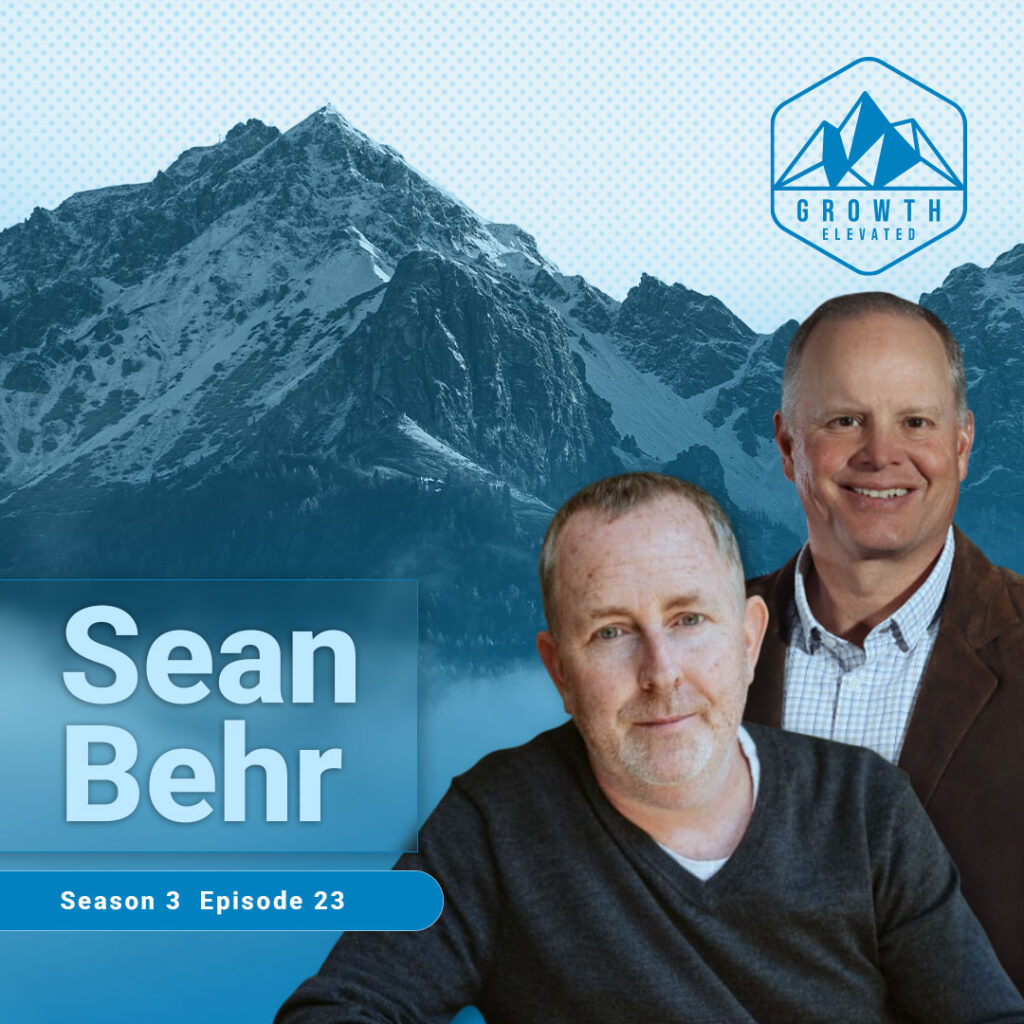
Zero-Based Leadership: How Sean Behr Scaled Fountain AI to Support the Global Frontline
In this episode of the Growth Elevated Leadership Podcast, Julian Castelli interviews Sean Behr, the CEO of Fountain AI. Fountain is the leading platform for companies that rely on high-volume, frontline workforces such as those in delivery, retail, and logistics to hire and manage their teams at scale.
Sean shares how Fountain was born out of the gig economy explosion, providing the technology needed to hire thousands of workers quickly through mobile-first, automated workflows. He discusses the “dopamine hit” of solving unsolvable problems and provides a masterclass on evolving from a one-product company into a multi-product leader.
Key Takeaways:
Mobile-First for the Frontline: Understand why traditional hiring tools like email and LinkedIn fail for the 80% of workers who live on their phones and communicate via SMS or WhatsApp.
The Speed of High-Volume Hiring: Learn how Fountain compresses the “sales cycle” of hiring by using AI interviewers and instant text communication to prevent candidate drop-off.
Zero-Based Leadership: A leadership framework where you start with a “blank whiteboard” to determine which meetings, emails, and tactics are actually driving results rather than just repeating what you did last year.
Scaling Product Lines: Why Sean bet on building 12 products instead of one, and the “hurdle” process used to ensure new ideas have immediate customer demand.
Intentional Communication: How vague terms like “Enterprise” can lead to misalignment and why CEOs must be crystal clear with their definitions to ensure the message lands as intended.
Peer-to-Peer Learning: The value of seeking out leaders in completely different industries to find “diamonds” of inspiration for your own business growth.
Ready to take your leadership to the next level?
👉 Visit us at GrowthElevated.com
📲 Follow us on LinkedIn for daily leadership inspiration and updates.
Transcript
Julian Castelli (00:01.464)
Hello, this is Julian Castelli. I’m the host of the Growth Elevated Leadership Podcast, where each week we talk with inspirational entrepreneurs and leaders in the tech industry. Past guests have included CEOs and CXOs of great companies like Workfront, CHG Healthcare, Pathology Watch, InMoment, Canopy, the San Francisco 49ers, and many more. This episode is brought to you by Growth Elevated. Growth Elevated is a community of tech founders, CEOs, and CXOs
who are committed to working together to share best practices and learnings in an effort to help all of us become better leaders and be more successful at our work and our lives. We do this through educational programs like this podcast, as well as our blog and of course our annual Ski and Tech Summit, where we bring leaders from across the world to beautiful Park City, Utah to enjoy camaraderie and collaboration in the beautiful mountains. So if you enjoy skiing in the outdoors, you enjoy talking with other tech leaders, check us out at growthelevated.com.
and please subscribe to this podcast wherever you listen to your podcasts. Today, we are privileged to welcome Sean from Fountain AI. Sean is focused on helping global enterprises unlock the full potential of their frontline workforce. Fountain AI’s native platform automates and streamlines how companies hire, onboard, and manage high volume teams.
This enables HR and operation leaders to move faster, make smarter decisions, and stay focused on what really matters, which is people and performance. Before joining Fountain, Sean founded and led Stratum and Xerx, built intelligent logistics solutions for the mobile industry. Earlier in his career, Sean held leadership roles at Adapt TV and shopping.com, where he learned firsthand how technology can reshape industries when paired with the right people and the right
right vision. Please welcome Sean Baer to the podcast. Thanks, Sean.
Sean Behr (02:01.55)
Hey Julian, it’s great to be here. I love hearing that bio, but yeah, it’s great to be here and it’s great to see you. It’s a big journey. Sometimes it takes a second to be like, oh yeah, I did all that.
Julian Castelli (02:07.531)
Well, it’s been a big journey, right?
Julian Castelli (02:14.167)
Well, you have lot to be proud of. Why don’t you walk us through it? So we’re going to talk to you about your leadership at Felton, but talk us through, like, how did you become a CEO tech leader? What was the path? Did you think you were going to do that early on?
Sean Behr (02:25.134)
Not really, I guess I thought I’d be a lawyer or something. But I happened to graduate from university at a time when things that were not possible were suddenly possible. Due to technology, due to the proliferation of internet and mobile devices, which just opened up lots of opportunities to do things.
Julian Castelli (02:36.907)
the time you can. It’s not possible.
Sean Behr (02:55.318)
And so I think I sort of stumbled into entrepreneurship and I think I got addicted to the idea of sort of being able to solve problems pretty quickly, like finding big problems that didn’t seem solvable and using technology to solve them was sort of this dopamine hit. And some of them,
Julian Castelli (02:55.946)
So I think I sort of stop.
Julian Castelli (03:10.973)
Mm-hmm.
Julian Castelli (03:14.7)
Yeah, is kind of exciting, right?
Sean Behr (03:21.824)
It is, it’s just exciting. And sometimes it was a big dopamine hit, like you built a new product that really took off. But even small things, just like the ability to make a profound difference day in and day out has just kept me in the world of tech, now through four companies.
Julian Castelli (03:39.925)
So what was your background before you founded these companies? You said you wanted to be a lawyer? You’re a history major, wow.
Sean Behr (03:46.862)
Yeah, was a history major. thing I didn’t go into that. I don’t really get much value out of it unless you and I go play some trivia, then I’m a good…
Julian Castelli (03:59.671)
Well, it’s a good validation of liberal arts, right? Because you learn how to investigate, how to research, how to think critically, and now you’ve applied that expertise in the tech industry, solving problems.
Sean Behr (04:04.942)
Exactly.
Sean Behr (04:15.128)
That’s right. Well said. Better than I would have said it.
Julian Castelli (04:19.498)
Well, I’m paying for a couple college tuitions these days. So I better be able to state the value prop because I know I’m paying for it. Well, awesome. So you made your way to Fountain. And I’d like you to tell us how you got to Fountain. But then I really want to go deep into what Fountain does because I think it’s a really exciting solution. But tell us about your journey. How’d you got to Fountain where you’re currently the CEO? And then we’ll talk about what Fountain does.
Sean Behr (04:22.082)
There you go. Now you gotta give yourself some credit as well.
Sean Behr (04:37.56)
Yeah, sure.
Sean Behr (04:45.42)
Yeah, sure. I’ll just kind of in one sentence, I’ll tell you what Found is and I’m sure we’ll come back and talk about it. But because I think it’ll help bring some context to sort of the journey. But Found is basically focused on the frontline worker population. So you can think of all the people on the front lines of our economy that make our economy work. You know, they’re delivering our packages right now for the holidays or their retail stores or their security guards and pharmacy technicians and
Julian Castelli (05:00.121)
Yeah
Thank you.
Sean Behr (05:14.35)
You know, they’re working in restaurants.
Julian Castelli (05:17.509)
Huge part of the, what percentage of the workforce is that?
Sean Behr (05:19.79)
It’s huge. Globally, it’s like 70 or 80 % of the global population. So I think we spent a lot of time with non-desk workers.
Julian Castelli (05:26.867)
Wow. So these are non desk workers. They’re not sitting behind a desk like you and I are right now. They’re on their feet. And of course they’ve got this computer in their pocket, right?
Sean Behr (05:35.598)
Yep, that’s right, they have a computer. This is it. So anyway, that’s what we’re focused on, is that worker population. The origin for Fountain and how I got involved with it is unique. At the time, when the company started, now I guess nine years ago, there were all these gig economy companies using the iPhone or the Android device.
Julian Castelli (05:52.283)
Sorry.
Sean Behr (06:04.28)
to deliver services to consumers. So you can get things delivered like from Uber Eats or Caviar or DoorDash. You could get a ride somewhere. You could get flowers delivered. You could get cookies delivered. You could get all kinds of things. And what was happening is these companies, these new companies needed thousands of frontline workers. They needed to hire thousands of frontline workers.
Julian Castelli (06:31.538)
If you accept their thousands of approve.
Sean Behr (06:33.952)
And nobody, no technology existed to help a very, very small company hire thousands of people. The only people that hired thousands of people had massive HR teams and…
Julian Castelli (06:47.689)
Yeah, because it’s a massive undertaking.
Sean Behr (06:51.19)
We basically built a piece of software that helped very, very small teams hire thousands and tens of thousands of frontline workers. And so most of the gig economy companies, and they’re still our customers today, use our software to onboard and hire these gig economy workers. So we basically sort of built the product for the moment of this transformation of, you know,
Julian Castelli (07:10.228)
Yeah,
Sean Behr (07:19.358)
Uber and Lyft and DoorDash and I’m leaving out hundreds of others. We’re going to build a new one there. I got to know the team. I actually was the first angel investor in Fountain.
Julian Castelli (07:29.044)
Okay, so you were an investor in the company, you’d been in mobile, you’d seen the challenge. This was your domain. You knew the problem you wanted to solve, so you got involved as an investor.
Sean Behr (07:32.255)
Yeah, I saw the challenge.
Sean Behr (07:40.11)
And I love the team. I love the team. Like the team was incredible. I believed in the opportunity. I believed in the frontline workforce. And so I wrote, you know, I wrote a check. I wound up becoming like a, I call an unpaid intern. Gave a lot of, I gave a lot of advice. I hope some of it was valuable advice. I became a board member later on. And then I,
Julian Castelli (07:56.915)
huh.
Julian Castelli (08:02.632)
people.
Sean Behr (08:07.63)
you know, the CEO is a very good friend of mine decided that he did not want to be the CEO anymore. He’s still involved in the company as a board member. And I said, okay, we’re gonna have to go find a CEO if you do a big search. And he said, nope, we don’t need to. We’ve already got person. I said, who is this magical person? He said, you. And I said, no way.
Julian Castelli (08:09.948)
Of course
Were you excited about that? Were you ready for that?
Sean Behr (08:35.278)
I was, after I talked a little bit more about it and thought more about it and what I could do here, it became more more compelling. And so I figured I was like, I’m already a board member. I’ve already been an unpaid intern. I’m already an investor. I might as well just, you know, work here and do it jump in. And so I became the CEO about four and a half, five years ago now. But yeah, it’s very rare to see a CEO who’s
Julian Castelli (08:45.693)
Jump in.
Sean Behr (09:04.814)
You’ve sort of been an investor, an advisor, a friend, a fan, a board member, and now here. think the interesting thing for me has been I have a lot of context for the challenges and the opportunities that the company faces today because I’ve seen it along the entire trajectory.
Julian Castelli (09:15.565)
Thank
Julian Castelli (09:20.538)
Yes. Right.
Julian Castelli (09:28.339)
the entire period. Yeah, absolutely. You have that perspective from the board level and now at the operations level. So how big was the company when you moved in as CEO, I guess five years ago, and then where are you today and where are you in the journey just in terms of where you want to go?
Sean Behr (09:43.35)
Yeah, yeah. At the time, probably were around 50 employees. We had a single product, which was the hiring product for frontline workers. And we had some nice little revenue going. was doing all right. From a revenue perspective, we’re up probably 10x since that. Yeah, we’ve got about
Julian Castelli (10:04.339)
from a mentally protected.
Julian Castelli (10:08.876)
Wow, in five years? Yeah.
Sean Behr (10:12.046)
200 and something employees, call them Fountaineers, right around the world. And we have, I think, 12 products. So we’ve gone from one to 12, from 50 to 200 employees. We’ve grown the revenue. We’ve grown the brand. We’ve grown our customer base pretty dramatically. So lots of good things.
Julian Castelli (10:21.734)
Okay, wow
Julian Castelli (10:32.304)
Well, the founder made a good choice in handing you the reins. That sounds like a lot of success. Well, congratulations. That’s awesome. So, so fountain is there. It is it is if you’re trying to recruit frontline workers, what makes it easier to do that? You know, we using AI are using obviously using the mobile device. I think that’s a key element versus a computer, right? But maybe walk through the before and after. if I’m
Sean Behr (10:36.169)
I hope so, yes.
Sean Behr (10:55.054)
Correct. Yeah.
Yeah, absolutely. So, is sort of, know, obviously we’re focused on this frontline worker population and we’re focused on the companies that rely on those frontline workers. That’s our customer. Our customer is typically the person who their business fails if they don’t have frontline workers. And we help our customers attract frontline workers, hire those frontline workers, onboard those frontline workers.
Julian Castelli (10:59.846)
look into higher.
Julian Castelli (11:10.128)
Yeah.
Julian Castelli (11:15.311)
Here.
Julian Castelli (11:19.109)
Mm-hmm.
Julian Castelli (11:27.085)
Let’s go through each one. How do you attract someone on a cell phone? Are you hitting them with a text message?
Sean Behr (11:29.964)
Yeah. You’re text messages and WhatsApp messages. You know, you’re putting things on Instagram or Google or Facebook. The thing that’s interesting, and maybe you’re before and after, right? For a knowledge worker, for an office worker, if you think about the standard office worker, at this point, most likely has a LinkedIn profile. Most likely has a resume.
Julian Castelli (11:45.402)
I apologize.
If you think about the standard.
Julian Castelli (11:55.723)
Right, you know where to go.
Yeah. Yeah.
Sean Behr (11:59.362)
Maybe it’s not up to date, but most likely has a resume. Most likely sits at a computer or a laptop most of the time. Most likely is very email proficient, uses email heavily during the day. And usually is trying to join, get a job where they probably are thinking that they want to stay at that company for
Julian Castelli (12:09.992)
Right.
Yes
Sean Behr (12:28.98)
years. Okay, so that’s kind of profile A. You’ve got profile B is the frontline worker. Okay, frontline worker does not have a LinkedIn profile, does not have a resume, does not sit at a computer most times, does not think of email as their first communication.
Julian Castelli (12:44.56)
It does not fit in a
Sean Behr (12:54.422)
And generally is not thinking that they’re going to join the restaurant and stay for five years. Maybe they’re going back to school. Maybe this is a second job. Maybe they just moved to a new city or maybe they’re going to move to a different area. They’re thinking of the job in months. I’m going to do this for six months. And so what’s interesting about it is if you have those two profiles, if you use a
Julian Castelli (13:05.526)
Right. Yeah.
It’s a tricky one.
Julian Castelli (13:22.0)
Technology.
Sean Behr (13:23.16)
technology that is good for hiring people who have LinkedIn and have resumes and do email and you just port it over to profile B and you start sending emails to people that don’t really use email, you’re not hiring anybody. So with Fountain what happens is we assume they’re on their cell phone, we assume they’re going to respond to a text message or a WhatsApp and so
Julian Castelli (13:27.062)
Check email, yeah.
Julian Castelli (13:43.471)
Yeah.
Julian Castelli (13:47.245)
Okay Okay.
Sean Behr (13:52.526)
you know, we assume that they’re not on LinkedIn. So when we go trying to attract them, we’re going to use different channels, different technology. But it might say something like, hey, Julian, you know, you used to work for us a couple of years ago. Would you ever be interested in coming back? Or, hey, Julian, you applied to work for us six months ago, and you didn’t follow through. You didn’t want it at that time.
Has anything changed that might want you to come back? And then obviously we’re gonna put you through a hiring process. So you’re gonna say, you’re gonna answer some questions all on your phone, and then you’re gonna do an interview with an AI interviewer.
Julian Castelli (14:35.763)
And you can do that multiple languages too, right?
Sean Behr (14:39.02)
Yeah, multiple languages, about 38 different languages around the world. And what’s great about it for the frontline worker and for frankly the company, the good side of this device, this phone is that it makes it really easy to apply to a job. The downside is that it makes it really easy to apply to a job. So I could start applying to company I just click a couple buttons and I’m applying to company B and company C and company D.
Julian Castelli (15:02.084)
So are people applying to multiple jobs?
Julian Castelli (15:07.709)
Yes.
Sean Behr (15:09.538)
Whereas if company A immediately texts me back and says, hey, Julian, your background looks great. Would you want to interview with our AI interviewer right now to just get things moving? You do the interview. Immediately you get a text message again that says, you seem like an even better candidate. Do you want to come in for a meeting tomorrow at 11 AM? Click this button.
Julian Castelli (15:13.667)
Yeah.
You want to better?
Julian Castelli (15:36.963)
So you’re compressing sales cycles. And because what happens? Time kills deals. Right? So a long manual process that lasts two weeks, I can find other things in that time, right? So you’re compressing using the technology to just be really quick.
Sean Behr (15:39.374)
Correct.
Until it all deals. Exactly.
Sean Behr (15:51.489)
Yeah. That’s a good analogy. And even, by the way, we know, the other thing we know is even after, and I’m sure some of your listeners know this, even after you get the signature on the contract, the deal ain’t done. Cause you got to get them from signature to launch. And the longer that goes out, the worse it is.
Julian Castelli (16:03.28)
Yes.
Right.
Julian Castelli (16:12.008)
Yeah. might find something. They might find another distraction. And everyone’s more distracted these days. They’re getting hit with more things every day.
Sean Behr (16:18.392)
So even if I have a great interview with the retail store and I walk out and I’m feeling pretty good, that company still needs to kind of connect with me and say, hey Julian, great job on the interview. Here are the four things you need to do now to have your first day be a success. It only is gonna take you eight minutes or 20 minutes or five minutes, whatever it is. So anyway, that’s a little bit about how the technology really works.
Julian Castelli (16:30.826)
YouTube.
Julian Castelli (16:39.31)
Yeah.
Sean Behr (16:47.98)
Our customers are going to hire millions of these workers around the world, 70 different countries. So a shameless plug, obviously, if you’re somebody who is passionate about this frontline workforce, if this frontline workforce is really important to your business, Fountain can make a huge difference. And even if you’re not a customer, we’ll teach you all the tricks of the trade.
Julian Castelli (17:10.209)
Yeah, sounds like a great, you know, where you started was the excitement of seeing new technologies to solve problems. This sounds like a really nice, nice convergence of emerging technologies, both the mobile and the AI and solving a problem that’s really built the suit for the customer. that’s fantastic.
Sean Behr (17:31.491)
Yeah.
Julian Castelli (17:33.283)
So you’ve grown the business, you know, tenfold, fourfold with people. What were some of the key achievements that you’re most proud of on that journey that, you know, when you started to now, it’s very different company. What are some of the things you’re most proud of?
Sean Behr (17:47.832)
Yeah.
Sean Behr (17:52.354)
You know, think probably a couple things that I’m really proud about. One is the talent, first of all, the talent we have here at Fountain, the Fountaineers around the world. I am, I’m just overwhelmed by how good they are on day in, day out basis. I feel like we give people unique opportunity to make a big difference in a big, a big part of the world.
Julian Castelli (18:12.942)
opportunity to a big difference.
Sean Behr (18:19.118)
And I’ve said this before and I’ve said this to founders as well. You know, I’ve built four businesses. There is something very, very special about building technology where someone gets a job.
Julian Castelli (18:28.014)
for something serious.
Julian Castelli (18:33.871)
Yeah, you’re having a huge impact in your life.
Sean Behr (18:35.906)
That’s a huge impact. So that’s kind of one thing I’m very, very proud about. The team we have here and their mission, their mission focus around this frontline worker population and opening opportunities for this frontline worker population. The second thing I’d say is, you know, usually a company, they build a product and then they improve that product and they get better at selling that product and they…
Julian Castelli (19:02.016)
I brought the third time that the different.
Sean Behr (19:05.282)
They do more better and different and they do it faster and better and they become the leader in that product. It’s rare to see a company have one product and then move and build additional successful products. It’s really, really challenging. You have a lot of companies that are essentially a one trick company.
Julian Castelli (19:11.662)
that are a content problem.
One.
Julian Castelli (19:21.304)
Yeah.
Julian Castelli (19:26.437)
Yeah, you distract your resources, you know.
Julian Castelli (19:33.996)
Yeah.
Sean Behr (19:34.414)
They try to do a second trick, but the second trick doesn’t work, or the third trick doesn’t work. And Fountain has 12 products that all have new customers. Yes, five conventional winners. Yeah, so the first thing, obviously, we build them with our customers in mind. I think from a leadership perspective, though, it was a pretty big bet.
Julian Castelli (19:38.05)
think it’s right as a blur.
Julian Castelli (19:44.002)
So how did that come about? you defied conventional wisdom. Tell us about what those products are and how did you get there?
Julian Castelli (20:02.22)
Yeah, I, that creates risk.
Sean Behr (20:04.556)
Yeah, huge bet. Huge risk. Could be a distraction, a defocus, it might not work, all these things. The good news is we had a great customer base basically pushing us. The thing that is hard, I think maybe this will resonate with some of your CXOs and your CTOs, certainly your CTOs, is there comes a point in a company and a product where the…
Julian Castelli (20:14.957)
This is getting a bit comfortable.
think that is hard and I think that needs to be lessened in terms of your TXO, your TTO, your TTO.
Sean Behr (20:34.382)
marginal improvement to the product becomes smaller and smaller and diminishing returns on the investment. And in the beginning, the things that you’re adding to the product are huge areas and huge importance.
Julian Castelli (20:43.308)
Right diminishing returns Yeah, cuz you’re filling in core gaps
Sean Behr (20:56.074)
once you’ve been doing it for a couple of years, yeah, you’re still improving, but the improvements are now smaller and smaller and smaller. And frankly, the customer is not willing to pay you dramatically more money because you made this part of the product easier to use. And I think the trap lots of entrepreneurs get stuck in is they continue to feel like, I’ve got to make the product better and better and better.
Julian Castelli (21:01.303)
Yeah. Right.
Yeah. Right.
Sean Behr (21:25.144)
but they don’t realize that the investment is not paying off at the same ROI as it did in the first year or the second year of the company. And so we made the bet to say, hey, we’re going to build some new products to meet some new challenges with our customers. The benefit for us has been that we have customers who say, look, you’re hiring products great, but I’m not interested in changing how I hire right now.
Julian Castelli (21:45.356)
business, know, we products, but I’m not interested in changing how I hire right now. I often talk to them about the customer base. Yeah. So, are your products, are these new products adjacencies in the hiring process? Give me an example of one of these, one of these new products that you built and how it solved that problem.
Sean Behr (21:56.63)
If you don’t have another product to talk to them about, the customer basically, you basically say, okay, well, I’ll talk to you later.
Sean Behr (22:14.818)
Yeah, so you can think about it from, you know, from the moment this worker thinks about potentially working for the company to the moment they do an exit interview.
Julian Castelli (22:25.057)
Okay, so you’re still in the frontline worker life cycle economy. Yeah.
Sean Behr (22:27.874)
doing this front line work, but we’ve moved horizontally along the life cycle. So I’ll give you an example. have obviously your hiring product. One of the first things we built was an I9 product. And I9s are obviously they’re important government paperwork that we have here in the US. And what’s interesting is
Julian Castelli (22:48.709)
And what’s interesting is
Sean Behr (22:55.052)
Going back to that analogy of sales, you’d hire these workers and then they had to do this really, really annoying piece of paperwork. And some of them would say, this piece of paperwork is so annoying that I’m just going to go work somewhere else.
Julian Castelli (23:11.719)
I’m gonna balance this up easier.
Sean Behr (23:14.912)
If you can make it super easy for them to complete that paperwork, more of those people become people who are happy employees on the first day. And so we built an I9 product. We have customers who only buy the I9 product. And obviously our pitch though is if you buy our hiring product and you put our I9 product there, now you’ve got one plus one, but it doesn’t equal two, it equals three.
Julian Castelli (23:42.347)
because you’re solving more steps in the process and you’re getting better retention, you’re not getting less bounce-offs.
Sean Behr (23:45.25)
And I’ll give you another one. Better retention, better throughput, the funnel works better. And then we have a time shift in attendance product. Obviously for this frontline worker population, they’re generally working shifts. So we sell that as a standalone product. But if you think about it, imagine you’re hiring people and you have our shift product, our time and attendance product.
Julian Castelli (23:56.064)
Yeah.
Mm-hmm.
Sean Behr (24:12.04)
During the hiring process you can ask questions like, Julian, what would be your dream schedule for the next three months? And then automatically feed that into our time shift and attendance product. And now your first week, it looks like magic to you as the worker, because you’re like, wait, I told them I didn’t want to work on Tuesday mornings and Thursday nights. And magically,
Julian Castelli (24:20.139)
Right. I told them I did want her on.
Sean Behr (24:40.524)
I’m not working on Tuesdays and Thursdays.
Julian Castelli (24:42.724)
Yeah, that’s not just efficiency, that’s creating a better experience.
So what were some of the challenges of creating these multiple products? mean, the positives we just went through, any downside?
Sean Behr (24:59.522)
Yeah, there’s lots of downsides. So if the listeners are feeling like, this is it, I figured it out, this is so easy, let’s just go do it. Unfortunately, that is not the case. There’s obviously some hard work. So one is figuring out what products to build. That’s kind of a core thing. You can build anything. And it’s getting, frankly, easier and easier to build.
Julian Castelli (25:19.082)
Mm-hmm.
Julian Castelli (25:25.633)
Yeah. Have you ever walked away from any products? So 12 is the ones that survived. But there’s the.
Sean Behr (25:25.966)
But building the right thing, I think, is getting harder and harder, while simultaneously getting easier to build anything, it’s getting harder to build the right things. So that’s kind of one challenge we have, yeah, absolutely.
that survived, yeah. We have a unique process that a product needs to clear certain thresholds early on to actually make its investment case. And so we’re constantly coming up with ideas. Frank, ideas are everywhere, right?
Julian Castelli (25:52.35)
your professional OZR.
Julian Castelli (26:05.912)
Yeah, is there is there a benchmark there like what’s the hurdle that you guys use internally like, okay, we’re we’re gonna we’re gonna make some investment this product but we’re gonna if you have a really clear hurdle in mind that this is a go or no go based on X that’s certainly helpful when you have a portfolio.
Sean Behr (26:19.822)
Yeah, we want to see existing customers signing up for a beta within the first 90 days. So while we’re even building it, we want to see at least three to five existing customers raise their hand to say, I want beta access to this. If we can’t get that, no matter how good the idea is, we generally putt.
Julian Castelli (26:41.874)
Yeah. Yeah, that’s a you don’t waste your time. And how do you communicate these new opportunities to your customers? Do you have a good customer success team that’s sharing this information?
Sean Behr (26:50.05)
Yeah.
Sean Behr (26:55.79)
great customer success team, yeah, that is constantly bringing up. In fact, I’ll give you a second challenge. We had a little bit of a worry that we were fatiguing our customers with too many new products. We have found the opposite there. Customers, especially if it’s opt-in, obviously, customers…
Julian Castelli (27:08.958)
Sure, yeah, mean 12 is a lot.
Julian Castelli (27:19.177)
I’ll be in.
Sean Behr (27:21.9)
You’re not going to fatigue them by showing them new, innovative, investing ideas. You know, they may not want to buy all of them, but they…
Julian Castelli (27:29.58)
But if they’re really going to provide value
Sean Behr (27:35.074)
And even if it’s not perfect for them, they like hearing that you’re as a company are investing. I made with the right partner.
Julian Castelli (27:43.741)
Yeah, you’re an innovator that makes it feel like they were the right groups that they don’t have to go find multiple other vendors, right?
Sean Behr (27:50.254)
The last thing I’d say from a challenge perspective that you know any of your listeners who are thinking about this Even if they’re not going to 12 products, which is crazy Even going from 1 to 2 or 1 to 3, you know is it Your your go-to-market Also needs to innovate because If you only have a single product that does a single thing your go-to-market engine is pretty
Julian Castelli (28:10.19)
Yeah.
Sean Behr (28:19.894)
is relatively simple. No, by the way, no go-to-market mentions are simple. So I probably shouldn’t say that, but I think your listeners will appreciate what I’m trying to say, which is that, you have a single marketing message. You have a single sales pitch. You’re pitching one ICP who traditionally buys this one thing that solves this one challenge or opens up this one opportunity. When you have three products,
Julian Castelli (28:36.311)
Thank you.
I understand.
Sean Behr (28:48.63)
Now all sudden you still have that one sales call. So you’re meeting a new customer for the first time. And instead of knocking over the head with here’s the one thing we do, you now need to say, Fountain does three things. And here’s what these three things do and here’s how they work together. And the customer, it’s a different go to market motion.
And especially if you have 12.
Julian Castelli (29:19.35)
Yeah, yeah, that’s a lot more complexity for sales organization. Well, that makes sense. Yeah, so it’s not. Yeah, you do have to innovate in the go to market and probably a lot more training and complexity there. But, you know, when we were talking earlier, you had, when I asked you to kind of what saw some things that could.
Sean Behr (29:21.838)
Yeah, so anyway, those are some of the downsides.
Julian Castelli (29:42.396)
Lessons from the experience you talked about zero base budgeting and you had a concept about zero base leadership. Tell me a little bit more about that, please.
Sean Behr (29:48.3)
Yeah. You know, I think what I’ve been thinking a lot about, right, is that the leader I am today is dramatically different than the leader I was a year ago, two years ago, four years ago, six years ago. And it isn’t that, it isn’t that like my leadership style has dramatically changed. There’s some things that are constant throughout that.
Julian Castelli (29:59.208)
different.
Julian Castelli (30:11.328)
think that like my leadership style has dramatically changed. There’s some things that are, there are things that I’ve been telling for three or five years now that now I do it and I think other folks, three four years ago, that’s that period. That is not.
Sean Behr (30:17.614)
But there are things that I would not have done three or four years ago that now I do and and and frankly I would have told you three or four years ago. That’s bad leadership And now I’m like, nope, that is not bad leadership And so I’m what I’m what I’m what I’m sort of always focused on is how am I evolving as a CEO and as a leader? in a company
Julian Castelli (30:39.767)
Yeah.
Sean Behr (30:44.962)
this concept of zero-based leadership, right? We have this concept of zero-based budget, right? Which is like you say, listen, just because we spent $300,000 last year, it doesn’t mean that we start this year with $300,000 and then we determine how much more we want to spend or how much less we want to spend. How about we start with zero and we say, was the $300,000 worth it last year? And if it was,
Julian Castelli (31:03.875)
Right. Yeah.
Sean Behr (31:13.538)
should we have spent more or less and it was it was worth it didn’t work well we’re not going to do it again we’re actually going to do zero okay
Julian Castelli (31:23.048)
Right, so you got to ROI on every spend. That’s the concept of zero based.
Sean Behr (31:26.894)
correct. Right. And it forces teams to sort of really evaluate sort of the conventional wisdom, the stuff that just kind of like, well, we got to do that because we’ve always done it. Do you really? Now take that concept and apply it to leadership, right? Which is to say, imagine you could say, tell me, go to the whiteboard with your leadership team.
Julian Castelli (31:36.309)
Right. Yeah, but do you really?
Julian Castelli (31:48.919)
Okay.
Julian Castelli (31:52.399)
Yeah.
Sean Behr (31:56.609)
and on the whiteboards write down all of the leadership tactics, strategies, practices, how, you know, we have to have a leadership, weekly leadership meeting on Monday. We have to have a CEO email on Tuesdays. We have to have a monthly all hands on Thursdays. We have to…
We always do this and this is what we do and here are our values and here’s the leadership principles that we bring forward and this is how we promote people. You know, put it all on the whiteboard. Look at it and say, okay, now let’s go on this other whiteboard, which is blank. What from that whiteboard is actually gonna help us drive this company forward?
Julian Castelli (32:44.385)
See, you stack rank them, right? If you can only pick three or four, otherwise you get so much time, you don’t have time to do anything other than just go through your routines.
Sean Behr (32:46.318)
and you say, correct. And what happens sometimes is you look at the whiteboard and you say, you know, I know that I always write a monthly email. And what happens is someone will say, people don’t really read that email anymore.
Julian Castelli (33:08.474)
You just freed up how many hours?
Sean Behr (33:09.784)
Yeah, exactly. Right? And so I’m constantly looking at like, what am I doing as a leader that’s working? And what am doing as a leader that doesn’t work anymore? And what new things am I bringing to the table? So that’s what I mean by this concept of zero-based leadership.
Julian Castelli (33:16.238)
Yeah.
Julian Castelli (33:20.23)
I that. Yeah, that’s really great. A great concept. it’s the the tied to zero based budgeting. We’re looking at it from the bottoms up is a great one. So you know, you’ve you’ve had a lot of experience now as both a board member and a CEO and you’ve grown this business. If you look back and you’re talking to some of our listeners, you’re wondering, you know, what are some lessons? What would you do differently if?
Sean Behr (33:48.952)
Yeah, what did you do?
Julian Castelli (33:49.894)
if you’re starting over, right? You get a chance to do the way back machine.
Sean Behr (33:53.015)
Yeah, and by the way, this is one of my favorite interview questions. I’m really interested in, I’m not interested in somebody who doesn’t know that they’ve made mistakes. I’m interested in somebody who knows they made mistakes and is clearly able to delineate what didn’t work and here’s how I would do it differently. It’s an incredible skill in startups and technology in particular, because we know
Julian Castelli (34:03.313)
Right.
Sean Behr (34:22.146)
that you’re gonna make mistakes. We know we’re gonna design products that don’t work as well as they should or design marketing events that don’t go off the way we want them to go off. So I think one thing for me, a core, core, core lesson is having even more respect for the language that I use with the team.
Julian Castelli (34:33.204)
Right.
Julian Castelli (34:45.658)
language that I use.
Sean Behr (34:50.35)
And I don’t mean language like bad language. mean, being really intentional, having more respect for actually what I’m saying so that it is crystal clear to the team. I’ll give you a tangible example. A couple of years ago, we had a major initiative to shift our company to focus on enterprise customers.
Julian Castelli (34:51.334)
But I don’t eat like it’s like bad language. I mean.
Julian Castelli (35:03.253)
I’d like to a simple example. Years ago, we had an initiative to shift our company to focus on certified technology.
Sean Behr (35:21.038)
I put it up on whiteboards, I put it up in slides, I wrote it in emails. Win enterprise customers, winning enterprise customers is really important. Winning enterprise customers. What I didn’t do enough of was clearly articulating the exact definition that the CEO had for enterprise customers.
Julian Castelli (35:21.672)
I put it up on. I put it up in. It was.
Sean Behr (35:50.285)
And what happened was we signed up customers, but they weren’t the enterprise customers I was talking about.
Julian Castelli (36:01.446)
Because people have different definitions of enterprise. Yeah.
Sean Behr (36:03.758)
Correct. Any big company is enterprise. And I was like, no, no, whoa, whoa, whoa, whoa. That’s not actually what I meant. And what I should have said is something like, our mission right now, or our big goal, is to sign 20 companies that are Fortune 500, US-based Fortune 500.
Julian Castelli (36:07.332)
Yeah.
Sean Behr (36:33.218)
Here is the list.
Julian Castelli (36:34.947)
Yeah, this is precisely what I mean by the enterprise customer.
Sean Behr (36:37.39)
enterprise customers. And so one of the things I constantly, you know, I’m thinking about an area where I think I just continue to need to do better is to be even more intentional about what I’m communicating and make sure that not only am I communicating it, that it’s actually landing over there where you are.
Julian Castelli (36:58.436)
And they’re they’re understanding it the way you mean it That’s huge because the the the words of a leader are so important people are gonna take them But if they take them you get the telephone game by the third time, right? And he said wait, did I say that well?
Sean Behr (37:00.878)
Correct.
Sean Behr (37:14.008)
Yeah.
Julian Castelli (37:14.03)
That’s what people repeated it, right? So that’s a great leadership lesson. Thank you. Thank you for that. And thank you for sharing this story. So as we wrap up, as you’ve learned in your leadership journey, from doing, but also from reading what’s out there and looking at best practices, do you have any favorite books, blogs, podcasts that you’d recommend that people wanna sharpen their leadership skills?
Sean Behr (37:40.271)
Yes, I do. And I have a goal for next year, which maybe I’ll throw out there and maybe by telling all these listeners, I won’t be able to hide from the goal. I think, first of all, there’s so much great content out there and things like the Growth Elevated podcast being a great example. It almost feels like I’m waiting for a vacation so that I can catch up on all the great content that I want to.
Julian Castelli (37:53.041)
First of all, there’s so much.
I bookmark all sorts of things. I’ve got a limitless list of them as well.
Sean Behr (38:11.406)
Yeah, so obviously you guys did such a great job, but Lenny’s, Lenny Rzyszczewski, he’s super product guy. Obviously I’m a product guy at heart, so that’s really interesting to me. A good friend of mine, Nikhil Basu Trivedi, writes a great blog called Next Big Thing, which is focused on sort of like what are these big rocks in the world. He works for VC and does a great job.
Julian Castelli (38:17.944)
Then his newsletter. He’s super product guy.
Julian Castelli (38:33.659)
I love that.
Sean Behr (38:38.894)
Harry Stebbings at 20 Minute VC just gets some incredible guests where I always find myself learning something interesting. I think Andreessen does a great job with their blogs, putting out really interesting and thought-provoking content. But I think for me, I’m not only, one of my goals for 2026 is not only to kind of continue to engage in some of this great content,
Julian Castelli (38:46.979)
Yeah.
Sean Behr (39:06.946)
But I’m gonna try to make an effort to seek out leaders who are not directly in my industry that have done things like, hey, I’m in a completely different industry from you, but I’m one of the best at growth marketing. I wanna go, not just read their blog or…
Julian Castelli (39:15.563)
I’m going to
It’s not such a big deal to involved or, you know, because they’re thinking both. But the fun thing is I can find the time to spend, and, you know, everybody comes with a few features that I can spend the rest of my time with. And, you know, what’s not even, like, it pulled me out, is that I’m entering fintech. I’m not into what I’m doing, but it’s interesting. It’s got me thinking, and maybe I could…
Sean Behr (39:35.907)
you know, read their LinkedIn post. But wondering if I can find some time to spend some time, you know, every month with a few leaders that I can spend 30 minutes with or an hour with and see what diamonds I can pull and say, wow, okay, you did that over there in FinTech. Has nothing to do with what I’m doing, but interesting. It’s gotten me thinking that maybe I could kind of parlay that into something on our side.
Julian Castelli (40:03.682)
and I think that is something on our side. Absolutely. It’s so valuable to have a peer network that you can learn from and have it. like you’re right, sometimes when it’s a different angle but a similar type of problem, it really allows you to open up more options and creativity. And that’s a big part of what we do at Growth Elevated, too. So I definitely see that. Sean, thank you so much for your time. Thanks for sharing this story. Congratulations on all the success.
Sean Behr (40:11.758)
You know better than most.
Julian Castelli (40:32.858)
And I look forward to watching the continued growth of fountain AI.
Sean Behr (40:38.37)
Sounds great. Julian, thanks so much for the time. Take care.
Julian Castelli (40:40.929)
All right, take care.
Timestamp
Introduction & Guest Welcome (00:00:01)
Julian introduces the Growth Elevated Podcast and welcomes Sean Behr, CEO of Fountain AI.
Sean’s Path to Tech Leadership (02:14)
Sean shares how he unexpectedly entered entrepreneurship and became a tech CEO.
What Fountain AI Does (04:45)
Overview of Fountain’s mission to support frontline workers and the businesses that rely on them.
Why Fountain Was Built (05:52)
How the gig economy created massive hiring challenges Fountain set out to solve.
From Investor to CEO (07:29)
Sean explains his transition from angel investor and board member to CEO.
Scaling the Business (09:43)
Growth from 50 to 200+ employees, major revenue expansion, and a broader product suite.
Frontline vs. Knowledge Worker Hiring (11:27)
Why traditional hiring tools fail for frontline workers and how Fountain adapts.
Speed & AI in Hiring (15:02)
How faster, mobile-first hiring improves conversion and retention.
Building Multiple Products (19:05)
The strategy, risks, and rewards of expanding beyond a single product.
Zero-Based Leadership (29:48)
Sean introduces rethinking leadership habits from first principles.
Leadership Lesson: Clear Communication (34:50)
Why precision in language is critical for effective leadership.
Learning & Leadership Resources (37:40)
Sean shares favorite content and his approach to continuous learning.
Closing & Takeaways (40:03)
Final reflections and wrap-up of the episode.