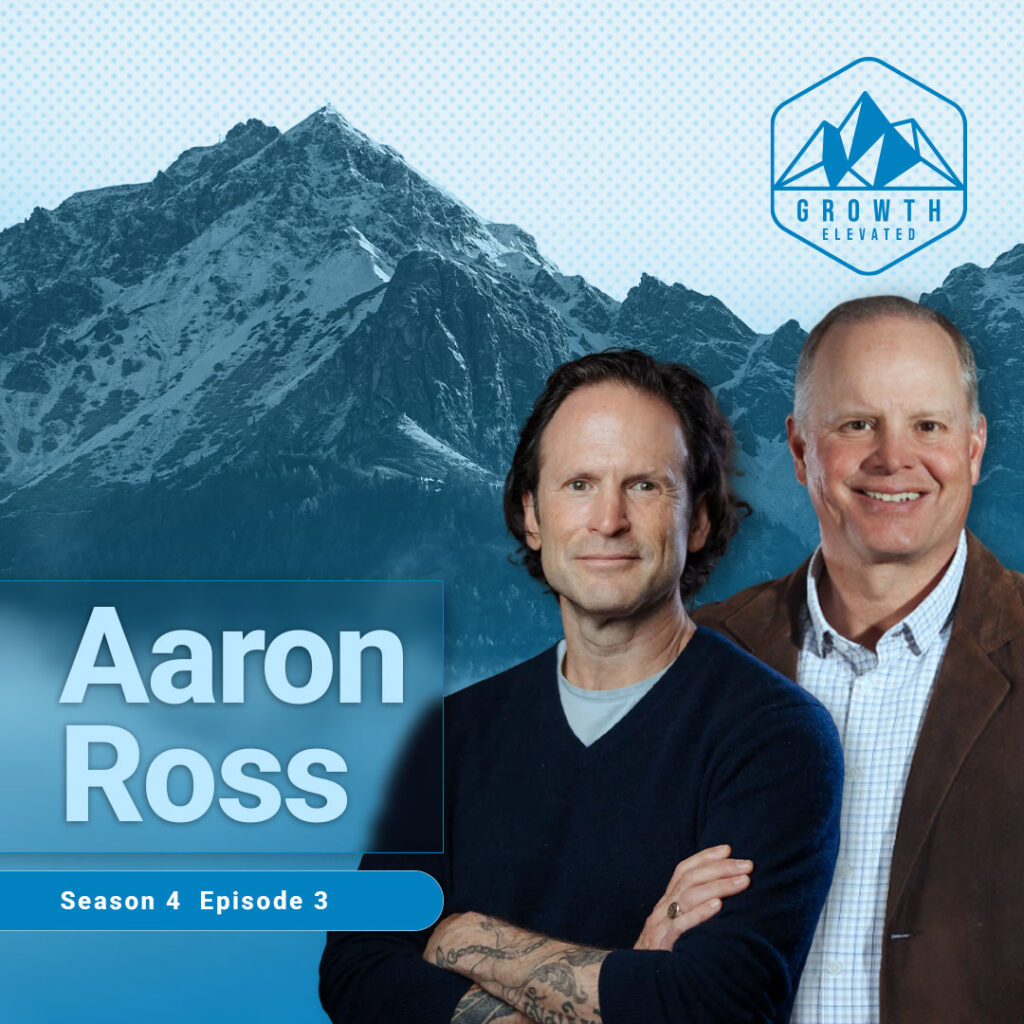
In this episode of the Growth Elevated Leadership Podcast, host Julian Castelli sits down with Aaron Ross, bestselling author of Predictable Revenue and a pioneer of modern outbound sales.
Aaron reflects on how sales have evolved as AI, automation, and new communication channels reshape go-to-market strategies. While sales tactics continue to change, he explains why the core principles behind building a pipeline and driving growth remain essential.
The conversation also explores the shift toward more nonlinear growth models, where relationships, trust, and multiple income streams play a larger role in building sustainable revenue.
For founders, sales leaders, and operators navigating an increasingly unpredictable business environment, this episode offers valuable insights on adapting sales strategy for the AI era.
Key Takeaways
Sales Tactics Change, Principles Endure
While tools and channels evolve, the foundational principles of building a pipeline and creating value for customers remain essential.
AI Is Reshaping Go-To-Market
Automation and AI are transforming how companies approach sales and marketing, requiring teams to rethink traditional outbound strategies.
Relationships Are Becoming More Valuable
In a world increasingly driven by automation, trust, personal relationships, referrals, and community are becoming stronger drivers of growth.
Growth Is Becoming More Nonlinear
The traditional, predictable, linear growth model is giving way to more dynamic and adaptable approaches to building revenue.
Multiple Income Streams Reduce Risk
For founders and operators, diversifying revenue streams can provide stability and resilience in uncertain markets.
Ready to take your leadership to the next level? Explore expert insights, practical strategies, and powerful tools to elevate your impact in business.
👉 Visit us at GrowthElevated.com
📲 Follow us on LinkedIn for leadership insights and updates.
Let’s grow together!
Timestamp
Introduction & Aaron Ross Welcome (00:03)
Julian introduces the podcast and welcomes bestselling author Aaron Ross.
The Origin of Predictable Revenue (03:25)
Aaron shares how his Salesforce experience led to the book and outbound specialization model.
Core Principles Behind Predictable Revenue (08:03)
Specialization, predictable pipeline generation, and structured outbound systems.
Is Predictable Revenue Dead? (10:54)
Aaron explains why the tactics have changed, but the core principles still matter.
From Linear to Nonlinear Growth (14:52)
Why traditional spreadsheet forecasting is breaking down in the AI era.
Short-Term Agility Over Long-Term Certainty (17:25)
Focusing on 30–90 day adaptability in an unpredictable world.
AI as Superpower, and Pressure Multiplier (29:46)
Why AI creates opportunity but also burnout and noise.
Building Multiple Income Streams (28:07)
Aaron previews Predictable Income and the case for diversified revenue sources.
Investing in Relationships as a Strategy (19:52)
Why relationships, team, customers, audience—matter more than ever.
Creative Connection & Unscalable Tactics (25:22)
Using books, speaking, custom coffee, cards, and artifacts to deepen relationships.
Writing in the AI Age (32:25)
Why depth, distillation, and lived experience still matter in content creation.
Redefining Safety & Adaptability (37:37)
Confidence, flexibility, and resilience as the new form of security.
Closing & Where to Find Aaron (36:14)
Information on Predictable Income and final reflections.
Transcript
Julian Castelli (00:03.284)
Good morning. This is Julian Castelli. the host of the Growth Elevated Leadership Podcast, where each week we talk with inspirational entrepreneurs and leaders in the tech industry. Past guests have included CEOs and CXOs of great companies like Workfront, CHG Healthcare, Pathology Watch, InMoment, Canopy, and the San Francisco 49ers and many more. This episode is brought to you by Growth Elevated. At Growth Elevated, we are a community of tech founders, CEOs, and CXOs.
who are committed to working together to share best practices and learnings in an effort to help all of us become better leaders. We do that through educational programs like this podcast, as well as our blog and of course our events, including our annual Ski and Tech Summit in beautiful Park City, Utah. So if any of that sounds interesting, please check us out at growthelevated.com and subscribe to this wherever you listen to your podcasts. Today, I’m super excited to welcome Aaron Ross to the program.
Aaron is an author and a speaker and a leader in the tech industry. wrote the famous Predictable Revenue book, which was a seminal book in my sales and leadership education. He wrote From Impossible to Inevitable. And coming soon, he’s going to talk to us about his new book, Predictable Income. Aaron is also a sales advisor and a global speaker and a board member.
And he’s renowned, he’s a renowned expert in the field and a very sought after speaker. And we’re super grateful and excited to have him on the podcast today. Welcome Aaron.
Aaron Ross (01:39.308)
Hey, Julie. Yeah, happy to be here. So. Yeah, it’s good. And by the way, it’s only a year ago. I in Park City at your event. It was fun. So.
Julian Castelli (01:41.62)
Good to see you, how are things going today?
Julian Castelli (01:48.768)
Yeah, we loved having you. Hope you can come again next year. It’s a beautiful time. It’s great. Yeah, now you’re in Scotland, right? that’s, you were in Los Angeles for a while. How long ago did you move to Scotland?
Aaron Ross (01:51.246)
Yeah, I’d to.
Aaron Ross (02:02.892)
Yeah, that’s why it’s morning for you, but it’s afternoon for us. Six years ago, just after, right before COVID literally, and everyone says, why would you move from Los Angeles to Scotland? again, we’ve got a lot of kids, we’ve got 10 kids, and we just felt like we want to be in Europe and we chose, we’d rather have the Scottish weather than the Los Angeles culture is the short answer.
Julian Castelli (02:24.092)
I think the Los Angeles might beat it out in weather, but yeah, very different cultures, I suspect. A lot less traffic, right?
Aaron Ross (02:28.27)
Yeah. Yeah. Anyway. Yeah. But yeah, it’s great being here. haven’t quite traveled as much as we’d like. Yeah. lot of traffic. I mean, there’s a lot of things to like about here. The weather. Yeah. Yeah. I mean, it’s the weather, but it’s right on the door. It’s in Europe. It’s on the doorstep of the continent. You know, it’s a short train ride down to London. Yeah, it’s great. I mean, I love being here and it’s a beautiful city. It’s all like stone and trees and green and it’s a central city.
Julian Castelli (02:56.616)
It’s very Harry Potter, right?
Aaron Ross (02:58.382)
Great coffee, yeah. And of course Harry Potter, a lot of magic and myth and gloomy, know, scary tale, all sorts of stuff here. So I like Harry Potter.
Julian Castelli (03:05.184)
It’s pretty neat and magical. That’s fantastic.
Aaron Ross (03:08.227)
Yeah, it’s, unfortunate. just, don’t, I’m not a fan of whiskey. So, yeah, living in Cuba and not like…
Julian Castelli (03:11.807)
man, and you’re in the best place in the world for it.
Aaron Ross (03:16.27)
I know, again, like, if you’re living Cuba, don’t like cigars, but yeah, no, but not a huge fan. I can tolerate it, but not a fan of it.
Julian Castelli (03:25.202)
Well, I managed to visit you once and then I look forward to our next visit together there. So, well, let’s catch up on what’s going on in the sales world today. Aaron, I want to let you know when I was my first time CEO, I hired a head of sales and the two of us got your book and we read it and we got together and we were looking like, man, can we do all this stuff? I…
I remember hearing it being referred to as the sales Bible of Silicon Valley. That was predictable revenue. What was the story behind that? What made you want to write that book?
Aaron Ross (03:58.264)
Well, that’s to that specific question. think there’s always been, you know, I think there’s some people who just have a calling to write a book, whether they realize it or not. And I did, I thought when I was in my twenties, it might be like fiction, it’s just never, you know, it’s like working at Salesforce. You know, and there I had a tech company that went bankrupt and partly because I didn’t know sales. So this is my late twenties, around 30. And so I got a job at salesforce.com. This is like 2002.
right after the dot com bust in the junior job of answering the 800 line, inbound leads and phone calls. And so I knew I wanted to learn sales and so getting a job in sales. And then I ended up saying,
Julian Castelli (04:42.984)
company called Salesforce is probably a good place to learn sales, right?
Aaron Ross (04:46.158)
Yeah. Well, exactly. You figure, you know, selling a CRM. I didn’t know. I was so clueless about that stuff at the time. Cause like, knew I wanted to do that. Yeah. And, know, I’d had in my company before we’d hired as a VP of sales and, I kind of abdicated understanding versus delegate. Um, so unfortunately, you know, that’s why I, you know, founders really need to sell, you know, themselves by hand for a while. Just so much pattern recognition. Um, you know,
Julian Castelli (04:49.596)
Yeah.
Julian Castelli (04:52.944)
I didn’t know what a CRM was either back then.
Julian Castelli (05:13.596)
Right, they have unique powers, right?
Aaron Ross (05:16.014)
Yeah, it was a different time and I was, you know, I was still pretty, I was really young. So that led to, but I knew if I went to Salesforce, I didn’t let my ego get in the way because it’s a very junior role, junior title, junior.
Julian Castelli (05:26.802)
Right. So you took a step back to make it leap forward.
Aaron Ross (05:31.31)
I took a step back ego-wise to take a leap forward and learning an opportunity. I I’ll just make something happen there. And then I ended up pitching and creating an outbound prospecting team doing, up being a lot of outbound email at the time. Some cold calling, but different types of calling and helped almost double Salesforce.com’s revenue growth and added within a few years, an extra hundred million and probably within a few years of that, an extra billion in revenue to them.
Julian Castelli (05:34.824)
Mm-hmm.
Aaron Ross (06:01.27)
and wrote the predictable revenue book.
Julian Castelli (06:04.094)
That was back in 2011 when you wrote the book, right?
Aaron Ross (06:07.07)
That’s when came out. I wrote it. Basically what happened was over the course… If you ask me how long did take to answer… How long did it take to write the book? Well, I did it over the course of like five years. I was blogging to find my voice, but I budgeted for topics and then…
Julian Castelli (06:18.376)
Wow.
Julian Castelli (06:23.452)
did you, did you use the blogging to kind of come up with the nuggets and the chapters? That’s, I do some of that too with this podcast.
Aaron Ross (06:27.811)
Yeah.
Aaron Ross (06:31.65)
Yeah. And at the time I kind of had, I was single. didn’t have, now I’ve got 10 children, but I could afford to write when I was inspired. And, you know, but I knew there was a book I wanted to do. So I think that I never wrote a book to kind of make money. It was always, I wrote a book because it was a calling and I still have that calling. So yeah. And it took, but I think five years of blog posts, then what helped make the book better.
Julian Castelli (06:55.516)
Ahem.
Aaron Ross (07:00.27)
And I would recommend this anyone who wants to do a book is, you know, by kind of working with, I did some consulting, working with customers, clients and talks. The refining, distilling, you know, cause you never really know like, you know, all this stuff, you know, how can you make it short and sweet and impactful? And it was like a couple hundred, 210 pages, 200 pages. So pretty short.
Julian Castelli (07:06.414)
Mm-hmm. Were you testing out the ideas? Would that work?
Julian Castelli (07:21.093)
Right.
Julian Castelli (07:25.116)
You know, I think that the fact that it was short and sweet and digestible was one of the strengths. remember when it first kind of crossed my path, I wasn’t like overly enthusiastic to read another book, but I remember reading it and saying, okay, that one was worthwhile because I was able to digest it and put things into practice. It was very, I don’t know, is it formulaic almost? It was kind of like the, how to build the sales machine or the factories, the way I remember describing it.
Aaron Ross (07:51.277)
Yeah.
Julian Castelli (07:51.386)
and being a little overwhelmed that there were so many steps, but you made it very clear as to, here are the steps and broke it down into very easy to understand, digest components was what I remember being impacted by the book.
Aaron Ross (08:03.417)
Yeah. Yeah. I really focused on like, what are the big things that make the biggest difference? Um, so there’s not a lot in there in sales process, right? There’s not a lot on there on comp plans. There’s a little bit. The main things were, you know, the core ideas to some, to sum up the book were, um, you need to create predictable revenue and you predictable pipeline. And by the way, at that point, that was basically still a new idea that took a break apart. This idea that salespeople created pipeline, you know, okay, separate pipeline generation and
Julian Castelli (08:21.756)
Mm-hmm.
Aaron Ross (08:31.138)
the jobs to be done of pipeline generation, inbound, outbound, you know, and renewals. So specialization core, right? And that’s by the way, we can talk about, know, if that still applies or not and how, so that was the sheet. Yeah.
Julian Castelli (08:35.494)
Right, specialization, yeah.
Julian Castelli (08:46.318)
I definitely want to get to that because there was a nice period where the formula that you put together in that book was repeatable and predictable. And I’m sure you talked to lot of people who came and told you about their success with it.
Aaron Ross (09:01.28)
Yeah, mean, a million. I don’t know how much money has been created from that process, but a lot. I can’t count how many people said it doubled their business.
Julian Castelli (09:07.142)
Yeah.
Julian Castelli (09:11.984)
That must be incredibly rewarding if people come share that story with you.
Aaron Ross (09:15.406)
Um, yeah, I mean, I appreciate it. You know, it’s all good. It’s, it’s, um, that and like speaking and writing the book, uh, there’s a lot, you know, around the rewarding parts, but, know, I think, again, one, just not to digress, but the idea of like lots of people using something to me, it’s all like ephemeral, like what’s a lot more rewarding. I do like that. It’s when one person says something, I assume a person, you know, if it’s a message, um,
But compared to having kids and a wife and family, it’s like the number of people, right? There’s something else going on. But yeah, that was the book. But specialization, key idea. The seeds, nets, and spears, like treating different types of weeds.
Julian Castelli (09:45.968)
Course, yeah.
Julian Castelli (09:50.31)
Sure.
Julian Castelli (09:57.944)
Yes, sir. I remember that this the nets and spears was great. Yeah.
Aaron Ross (10:00.95)
Yep. That’s a key idea. there’s a lot there was so it’s no most known for out like structured outbound prospecting. But again, that’s built on these other things. And I think the last idea that doesn’t really, I haven’t really heard people say this, but there’s a lot around the management side around like collaborating with your team versus, you know, either telling them what to do all the time or, you know, a lot of like manager to team collaboration. So
Julian Castelli (10:29.402)
Yeah, now I remember really, really enjoying it. Well, here’s the $85,000 question, right? It’s 15 years later, 2026, is predictable revenue dead? I know when you came out to our event last year at the Growth Elevated Leadership Summit, you gave a talk on that. And that’s why I wanted to share that with the podcast audience here. Is predictable revenue dead in 2026?
Aaron Ross (10:54.414)
Well, over the years, I’ve seen a lot of companies do this and there’s always someone who comes out and honestly started with Brian Halligan at HubSpot. Love him. But, and then lately he’s been guys like Adam Robinson on LinkedIn. I don’t know, but it’s this is a regular thing where some guy starts up. He’s like outbound. It interrupts people. know, it doesn’t work. It’s annoying and it doesn’t, and it’s dead. You know, what we need to do is X. So.
content marketing inbound. And for a while that works for them. it’s great, honestly, it’s great marketing, but then they always at some point switch to doing outbound. So that message stops because they realize they’ve plateaued or capped whatever their inbound is. They need to add more channels and go up market and so on and then outbound. to be fair, so yes, the tactics of predictable revenue are dead. And the metrics around response rates are irrelevant now. The basic principles are alive and well.
Julian Castelli (11:43.77)
Yeah, the tactics of creating a new and the answers to our questions are developing now. The specialization of the generation. I think that’s a topic of specialization more important than ever. What is keeping the work in the business? I think it’s effectively, we see that we’re kind of working on a compound and are maybe more
Aaron Ross (11:53.112)
So specialization, know, predictability generation. Well, we have to have some caveats, but like specialization, more important than ever, right? Whether it’s humans or agents, understand the different types of leads. So in the book, was seeds, nets, and spirits review, kind of word of mouth, outbound and marketing. That could be more finely sliced today, but you still have to treat different types of leads differently. You might be listing things like duh, but I can’t tell you the number of times executives look at
Julian Castelli (12:16.23)
I You might need that history of the time period to actually reduce the amount of time that you get. Yeah. And I think, I think this situation, I think, will be very interesting. But it’s a lot of interesting science. And I it’s a good, just a reflection of the problem.
Aaron Ross (12:22.178)
dashboards and just lump all the leads together into. Yeah. And the last thing, you know, so, especially predictable lead generation. I think I said that in season, it’s like a lot of those fundamentals and collaboration. Now there was something missing from that book, which was the first section of the follow-up book from impossible to inevitable, which was nailing a niche. yeah, was ideal customer profile. the same, same idea, but we just took.
Julian Castelli (12:43.922)
Nearly an inch, yeah. Yup.
Aaron Ross (12:49.674)
In the Impossible book, I did that with Jason Lemkin of Sastro. We just really dug into the psychology, understanding why there’s a gap between people. you know, I think it’s, you know, realize this, if you haven’t read Crossing the Chasm, it’s a great book to read. so this chapter, yeah, kind of explain why there’s a chasm to cross. And you really think about sales and marketing, it’s just a psychological exercise of people getting to know each other. Is there fit or not?
Julian Castelli (13:04.814)
Fantastic book, yes, about specialization and nail your niche, right?
Julian Castelli (13:16.631)
Mm-hmm.
Aaron Ross (13:18.146)
Hence, by so many dating jokes about pipelines and leads and things. So the nailing nailing and niche is more important than ever in the AI age. So I think most of the book, the principles, not the tactics are actually more important now and will be. However, sorry, got it. The asterisk.
Julian Castelli (13:21.059)
Yeah. Yeah.
Julian Castelli (13:32.089)
Well, you know, over the last couple of years, I’ve talked to a lot of people in the tech world and sales seems like it’s harder than ever. And it seems like there’s so many things that used to work, don’t work anymore. What are you seeing out there? Is this an economy thing or is this a change in the way people behave and the tools and
Aaron Ross (13:57.442)
Yeah, think it’s a, so I mentioned this asterisk on predictable lead generation. So, you where I believe, and I think this is a very foreseeable, you know, look, every, you can just look the noise, the amount of noise, overwhelm option, apps, messages, that’s only going to continue to Yeah.
Julian Castelli (14:15.107)
Yeah, it’s overwhelming. You wake up and you get to your computer and it’s just like throwing up at you almost, right?
Aaron Ross (14:21.388)
Yeah. so what happens is people’s attention span becomes a little more jagged. They tend to rely more on trusted, you know, for the most like trusted people, trusted brands. There’s some of
Julian Castelli (14:32.525)
Because if you’re overwhelmed with so much, you go back to your default. What, what, what, what, where’s my bedrock?
Aaron Ross (14:36.27)
Yeah, we can kind of talk about that. on the predictability side of what’s working, where I think, I’m working on a new book with my partner in Brazil. The working title is called Phantom Revenue.
Julian Castelli (14:51.417)
Okay.
Aaron Ross (14:52.806)
And there’s a couple key ideas in there. So I haven’t talked about that much. But one of them is the idea of trying to call out. Pardon for the name. So one is linear mode and one’s nonlinear mode. Linear mode means you can kind of spreadsheet it out. It’s the old predictable revenue method. It’s the way that all the go-to-market stuff, all the playbook. You just do x, you do y, you have six steps of stay-at-the-price. It’s like the marketing funnel.
Julian Castelli (15:12.885)
It’s math and pipeline and conversion ratios.
Aaron Ross (15:22.466)
a lot of that will continue to work, but a lot of it won’t with AI because of factors, noise, complicated buying processes. It’s just stuff. Okay. Okay. So a lot. then what was become more important is this nonlinear. I don’t have a better term like quantum is basically you can’t use a spreadsheet. you know, with AI, for example, there’d be a lot more funnels where you have like signals. You’re kind like, well, we’re doing all this stuff at the top and kind of stuff kind of falls out.
to sometimes the second stage and sometimes the third stage, but we don’t really know why. We kind of have a guess, but we don’t really know. if we do enough volume, then stuff comes out the bottom. So you can have some sense of one thing leads to another, but you have a lot less control. You have hopefully maybe influence. It’s kind of like the same idea, which is if you create great content, it’s the new version of.
HubSpot did do right, is if you create great content that people love, they’re going to come back. So that part of, there’s going to be a lot less of the predictability, which is if I do 10 times X things, then I’ll get three times Y and I close.
Julian Castelli (16:22.318)
Yeah.
Julian Castelli (16:32.576)
Right, you can’t just linearly increase it. And that’s what people are finding. They can’t just add to the stack and get the predictable results anymore. It hit a natural ceiling, perhaps.
Aaron Ross (16:35.309)
Yeah.
Yeah, so I can’t.
With the kind of like concrete activities, which is again, I do 10 calls, I pen things. so that’s going to be more of a thing, is this, can’t spreadsheet it out. You can’t control the inputs and outputs. You kind of have to trust that if you’re doing good things, you’re kind of like measuring what you can, but things that work out and you’re not going to able to predict your growth with a lot of concrete. Not that you can now anyway, by the way.
Julian Castelli (16:46.689)
Yes.
Julian Castelli (17:11.359)
I have found very few people, know, there’s the barbell end of the, there’s the hyperscalers that, you know, are going to the moon. But the traditional companies that historically had pretty good sales predictability is becoming harder and harder.
Aaron Ross (17:25.282)
Yeah. So that’s, think that’s going to be more of the norm, you know, for people, which is, you know, like you can have your goals, but you just can’t be too attached to how you hit them and when, and you just have to kind of keep, yeah, right direction in like, you know, short shorter term plans, like, okay, whatever your, your plans are pretty much useless. Three month plans are a lot more useful in big picture. Yes, you’ll have to have managed cash and these things, but, not putting, not over indexing on putting a lot of effort into big future plans.
Julian Castelli (17:37.739)
Focus on going in the right direction.
Aaron Ross (17:54.764)
When you really need to focus on short, know, doing more in the next 30 days, 90 days, and then evolving it to the next quarter type of thing. So.
Julian Castelli (18:02.315)
Yeah, and being able to react to what changes, right? So being optimistic.
Aaron Ross (18:05.806)
Yeah, you know, I mean, because everyone had a war with Iran and their budget, you know, and their planning forecast, right?
Julian Castelli (18:12.405)
Yeah, right. My God, the amount of surprises you wake up and boom, it’s another crazy surprise. So you have to be able to react, right?
Aaron Ross (18:20.534)
Yeah, but what you could do is, you know, quarter each quarter, you know, surprise number one, surprise number two. There are going to be surprises. Yeah, but the weird thing is.
Julian Castelli (18:25.963)
What are we gonna do with this quarter’s surprises? Yeah, I mean, imagine being a physical goods company importing things and trying to predict what was gonna happen with tariffs. I mean, it’s crazy.
Aaron Ross (18:35.95)
I mean, this is the features now, is, especially COVID and now AI, know, there’s this, there’s terrorists, I don’t there’s always something, right? And there’s, that’s not.
Julian Castelli (18:48.119)
It’s very hard, you your title was predictable and you know, just in terms of markets, markets like predictability and stability. And I think the markets haven’t had that for some time right now. Fortunately, the markets haven’t done too terribly yet, but I don’t know what’s holding it up. Hey, but there’s, listen, there’s five things that you kind of concluded in our talk that I want to just go through that, you know, maybe might be some ideas for the future. You talked about internal relationships and culture.
Aaron Ross (19:00.28)
Yeah.
Aaron Ross (19:19.928)
Yeah. Well.
Aaron Ross (19:50.594)
Yeah, there.
Julian Castelli (19:52.369)
but let’s pick up where we left off and we’ll see if we can slice everything together. So I was just mentioning there’s five things that you your talk that you talked about as things to explore in the future that you felt like you had some confidence in. Internal relationships and culture was number one. Sales relationships were number two. Events were number three. Systematic referrals were four. And personal publishing was five.
Which, you know, that was a year ago when you shared that with us. Which of those have you seen some good success with?
Aaron Ross (20:28.014)
Yeah, well, I’ll take a step back because there’s a core premise, you know, for what I see with AI and post AI is that no matter what happens with technology, if you invest in relationships, you’re going to do better, you’re going to be okay, or you’re going to be better than you would be. So relationships could mean investing in your relationships with your team, your executive team, with your customers, how your salespeople, if you have them interact with your customers.
Julian Castelli (20:50.843)
Yeah.
Aaron Ross (20:56.398)
It could be actually with your family, your friends. There’s a lot of forms of relationships. So those are examples. Okay, if you take that as a high level idea, like, what do I do with that? Well, okay, so with your team, that’s where those examples like, you know, getting to know your team better. You know, so with our business, my partner in Brazil, we call it, we want to, for us, we look at building a culture of kicks and hugs, right? So there’s, there’s actual caring, which is harder than ever over screens, you know.
Julian Castelli (21:25.921)
I that’s a, you got your next title for a book there, Kicks and Hugs. I think that’s pretty, pretty catchy.
Aaron Ross (21:26.528)
actual carrying, also when people need a kick in the butt. So it’s kind of balancing both, finding the right balance.
Aaron Ross (21:37.934)
Maybe. So that’s but that could be through your executives. I mean, you could use that. I mean, I tried that with our kids too. So, you know, it doesn’t work as well with your spouse. I’ve tried, trust me. That’s all. She’s the kicks on the hugs. But so, so that I’m just trying to bring down these examples of where can you invest? I’ll come everyone to be different. So some companies are investing a lot in community and partners.
Julian Castelli (21:50.249)
Hahaha
Yeah.
Aaron Ross (22:04.404)
Some might be that need to invest in their team. Some might be doing, there’s a lot that are doing the publishing, is, like I’m in what I’ve done, right. Create relationships, scale through books and some people do it through LinkedIn content. So that’s like a one to many relationship. So there’s a lot of ways to do it. A lot companies doing in-person events because you get that extra, you level of connection with people. They’re all good.
Julian Castelli (22:13.7)
Yeah
Aaron Ross (22:31.47)
Right. It’s almost like saying, which vegetable should I eat? Or maybe that’s not a good one. know, what exercise routine, how should I exercise? Should I do like high intensity or I don’t know, like you got to kind of find what’s your, what’s your personality, your type, your schedule and like find like one thing that you really can get better at the place to start and not try to do everything.
Julian Castelli (22:50.186)
But the vegetables or the exercise are relationships in general. So lots of different ways to build authentic relationships.
Aaron Ross (22:55.362)
Yeah. for me, I don’t know I’ve seen anything like work in particular out there. It’s not really what I’m keeping an eye on. I would say that I think a lot of executives, there’s one other, well, there’s one other core idea, but let me just, so on the relationship side, like what I’m working on, what I’m drawn to. So would say I’m working on a bunch of things now, which is mostly because I just want to. It’s not because I kind of penciled out what the future is going to be, but I’m just,
Julian Castelli (23:22.049)
without.
Aaron Ross (23:23.778)
I’m inherently drawn to some things. I just know they’re going to work out. Like I know relationships, these examples will be a way for people to succeed period and end of story. Yeah, the specifics will be different. But what I’m personally doing is I’m writing more books. I’ve got half a dozen books underway. It could be over the next few years. Some are with partners. Like I’m helping someone with a book that they came to. Some I’m doing myself. I just love books.
Julian Castelli (23:24.691)
I like hearing that.
Yeah, well you’ve been gradedly successful with it.
Aaron Ross (23:53.996)
Yeah. And I’m just getting started. So for me, books are a way to create new relationships. So I like them because I get to put ideas into place into an artifact and share them with people at scale. it’s because I’m a book person. love books, love reading books. I love story, you know, so I’m not doing that again as a, I should do it because I’m drawn to it. And then the other thing is I’m doing, you know, speaking again, getting to speak to people. don’t, webinars aren’t my thing. Like in person.
Julian Castelli (24:07.778)
you
Julian Castelli (24:13.504)
Yeah
Aaron Ross (24:23.238)
It’s another way to build relationships and I have fun speaking. A third thing I’m doing is partnerships. My business partnerships, I’m more of an amplifier than an operator. So I work really well when I’m helping someone else and making them better versus I’m, there’s some things I’m really good about doing the work, right? But they’re not really business things. It’s like, know, books, ideas, speaking. It’s, I don’t know, like, strategic content stuff that doesn’t work well in a company or a chart.
Board members stuff, I’m more like thinking, applying, leveraging, amplifying relationships. So when someone has a business or we have one together, if they’re operating it and I’m helping amplify it, that works really well. So I’m doing, some of those going. And then lastly, crafting is I’ve drawn, I use AI, I think a lot, comes and goes. I think I was like a top chat, GBT user, but not for coding things. It’s mostly for like book ideas.
Julian Castelli (25:09.422)
Mm-hmm.
Aaron Ross (25:22.83)
capturing ideas, and creating cool projects that, to me, I have a whole thing, right now it’s under ironcrown.co, but old school ways, unscalable ways of connecting with people. I have a typewriter here I got, because I’m going send some typewritten letters. I’m creating, I’ve got these kind of, I can create custom coffee brands. I haven’t created them yet.
Julian Castelli (25:38.979)
Yeah, see that. really? Tell me more about that. I’ve been playing around with coffee lately.
Aaron Ross (25:50.67)
Yeah, I mean, this is an example between I was creating these coffee brands just for fun. I’m like, this is cool. I’m having a good time doing it. I was doing it for my wife’s business and you can do it now. There’s like a printer I found that can do digital bags, like 200 bags, like 50 cents a bag. And you could do small lot things, right? So.
Julian Castelli (25:58.058)
Mm-hmm.
Julian Castelli (26:08.094)
So is this something like for an event or for a party you can customize the brand of the coffee?
Aaron Ross (26:10.806)
Yeah. So yeah. know, within a few months or something this year, I’m sure. Yeah, exactly. I can go to a company, probably some go to market company, but hey, you want to leave a cool go behind, leave behind at an event, 250 grand bags of coffee. We can just customize, create a custom brand because it’s just fun. You know, predictable fuel or something, whatever it is, create a custom brand that’s yours and you leave behind and you’re not making money selling coffee. You’re making money by creating a relationship with someone who might spend five figures or six figures with you.
Julian Castelli (26:14.722)
That’s a fun, fun gift, right?
Julian Castelli (26:21.504)
Yeah.
Yeah Yeah
Aaron Ross (26:41.336)
Same thing with these kind of business cards, know, called banana peel. They’re like a funny Dilbert type playing cards. And I’m going take packs and I’ve got a business partner in Germany and one in Brazil. And they’re going to try sending these packs of cards out to people they want meetings with or with customers. we’re not sure, like there’ll be some things they can share online because they’re funny cartoons. Clever, you know.
Julian Castelli (26:57.005)
Mm-hmm.
Aaron Ross (27:11.438)
But it’s fun. I make myself laugh sometimes I’m making these things. And so for me, it’s like, if I’m having a good time making these things, other people have a good time receiving them. And it’s stuff that again, AI can’t, I’m using AI, but I don’t see this being replaced by AI for this type of like right brain EQ type of connection relationship, something that’s just different. And it’s got, there’s a human element of taste so far.
Julian Castelli (27:30.437)
Right think point. I think relationship is different. That was a huge and L.T. still for these things. I’ve got a bunch of ideas and I think that…
Aaron Ross (27:40.046)
to these things where I get a bunch of ideas and I can kind of, it’s like a conversation with a business partner. I’m like, okay, this is okay, we gotta keep working it, working it, working it. And it takes a bunch of steps and it ended up with a great output. It’s funny, you know, could probably at some point share a screen. They’re on a website or ironcrown.co is, we got some samples. But, you and now you can get a printed like five of them, one or 20 of cards.
Julian Castelli (27:43.551)
It’s a public.
Julian Castelli (28:01.419)
Well, you got you have a
Julian Castelli (28:07.67)
So this is reminding me, your new book is coming out, I think it’s Predictable Income, right, that you’re working on. And a core theme of that, you were kind enough to share with me, is the ability to multitask and do lots of different things. And this is what you’re describing right now, right? You’ve got your books, you’ve got your speakers speaking, you’ve got your crafts, your business partners. Is that part of the idea of this new book that you can, in today’s world, you can have multiple income sources going on?
Aaron Ross (28:12.782)
Great to link up.
Aaron Ross (28:26.102)
is the partnership.
Aaron Ross (28:36.11)
Yeah, the book doesn’t anything is like my I kind of feel like the way I work is so odd. It’s hard to describe. It may not be a great example. However, with the book is great. The subtitle is basically how to create multiple income streams. You never have to depend on one job again. So the principle is
Julian Castelli (28:52.171)
Right. That’s what made me ask because it sounds like it’s exactly what you’re doing with your passions.
Aaron Ross (28:57.42)
Yeah, but the book would say find a job, like a salary job that has benefits, is like your stability, your base. And then over time, do part, freelancing, entrepreneurship, and then over a long, time, investing. And so, yeah, I do believe that. For me, I’m not a good fit and have been for like a real job job, but things like, which could be retainer clients, board memberships, royalties, there’s other sources of like recurring income I get.
Julian Castelli (29:13.642)
Yeah, nothing’s perfect, right?
Aaron Ross (29:26.402)
Because anyone who’s done full-time consulting can tell you that it can be a grind. There’s a lot of great things about consulting, a lot of things that suck, a lot of great things about jobs, lot of things that’s, you nothing’s perfect.
Julian Castelli (29:39.903)
Well, with AI today and with all the enablement, it’s easier than ever to be an entrepreneur and come up with a new idea and make something happen, just like you just described with those coffee bags.
Aaron Ross (29:46.658)
Yeah
Aaron Ross (29:51.456)
Yeah, well, this is the trick, right? How often is technology like think back, you know, what technology does it when I cart, you know, it’s just you can also get on a faster spinning hamster wheel. Yeah, so the people in the corporate world, I mean, you have a chance to make more money than ever. But if you if you’re on the corporate track, which doesn’t mean you’re in business, but it’s more like the class of corporate track, which is
Julian Castelli (30:04.905)
Yes indeed, right? Like trying to juggle too many things.
Julian Castelli (30:16.939)
Thank you.
Aaron Ross (30:19.406)
You’ll find what people do is they’re gonna work harder, be under more pressure, be surrounded by more stimulus, more FOMO. So it’s gonna make things better and worse at the same time. Because, you know, okay, you get a superpower.
Julian Castelli (30:20.683)
people do is begin to work.
Julian Castelli (30:25.641)
Hmm
Aaron Ross (30:37.71)
But everyone else has a superpower. So, you know.
Julian Castelli (30:38.826)
There’s a lot of technology that’s changing what superpower is these days and every day you wake up there’s a new thing.
Aaron Ross (30:45.582)
Yeah, exactly. So yeah, there’s a short-term advantage to lots of people, ultimately everyone’s going to have the superpowers in their own way. So unless you actually consciously step off and forge your own path, all the AI stuff is probably likely to lead to more burnout and maybe more money, but also more anxiety and burnout.
Julian Castelli (31:06.633)
Maybe more funny.
Aaron Ross (31:11.992)
That’s my, that’s my take. It’s great. I love it. mean, I’m use it, but I use it in a very supportive way. And I would love to use more of it and do more coding, but it’s just not the right time for me. And so I use it more, all kinds of stuff for, again, like the thing that’s magical for me is you can take an idea and do a prototype very quickly, whether it’s a book, a cover, wherever it is. And also just logging ideas and stuff. So there’s a lot of great stuff. And again,
Julian Castelli (31:12.811)
Totally yeah
Aaron Ross (31:41.966)
Listen to Elon Musk and people talk how in like a year or two things could get still crazy. For me, as much as I would be really interested in learning cloud code and open calling this stuff, I don’t really have a need for it. I don’t have the time to do it. I don’t want to make it a priority. And in six months, it’s all going to be all there.
Julian Castelli (32:00.815)
It is changing so rapidly that there’s constant, you you can
Take a few weeks or a month and there’s going to be something new to learn.
Aaron Ross (32:08.332)
Yeah, so it’s like, if you really, for people who are really dying and super interested, great, that will help them. But if you’re not like, just wait till it’ll catch up.
Julian Castelli (32:20.277)
So of all the different things you’re focusing on, what are you most excited about?
Aaron Ross (32:20.568)
So.
Aaron Ross (32:25.038)
I think I’m most excited by a lot. the big picture, okay, small picture, I’m most excited about the cards because I’ve been working on them for a while and I’m just waiting on my designer to finish the print ready version so I could get them printed and then send a prototype to my buddy in Germany. And then he’s going to do the Portuguese version. So to actually hold those in my hand would be cool.
Also, the predictable income book is almost ready in the next few weeks. That’d be cool. I like physical things and artifacts. In March, should be available privately. So we’re going to do the, you know, it’s available and we’ll tell our friends, try to get, buy them, do some reviews. And yeah, it’s been like three years. know, my, Smith, my coauthor, he came to me three years ago with this idea for this book. I’m like, that’s a great idea. And he’s like, oh, let’s get it done in this draft in three months.
Julian Castelli (32:54.402)
When is that coming out?
that’s exciting.
here.
Did you say upfront, did you warn it’s gonna take a process?
Aaron Ross (33:17.87)
I think AI was still, know, was an odd man’s
Aaron Ross (33:24.526)
I said like, it’s just a couple of years. And he’s like, no way. Three years later. Now to be fair, I mean, can you write a book in a weekend? Yeah, I kind of did. I’ve done that. My first book, CEO Flow, I did that. I know it’s a good book, but to write again, it’s so easy to generate good, it’s not hard to generate good stuff. Okay stuff. Yeah, that’s not challenging. If you want to succeed,
Julian Castelli (33:31.23)
Wow.
Julian Castelli (33:34.506)
And I’ve done that. First of all, I did that. Just a good book. But right again, it’s little easy to write, it’s not very good stuff. Or OK stuff. Yeah, that’s not good. Yeah. I think that’s another thing that people are just not used to. You know, what you’re actually watching is that you actually want to get better and better and
Aaron Ross (33:53.966)
So again, another thing in the future is how can you figure out what you’re actually drawn to and interested in so you actually want to get better and better and better better at it. And you can bring that certain vibe to it that you can’t just like popular, passionate, think about any like, yeah, popular musician, like they’ve just, they’ve got something they bring to it that you can’t always, or a dancer, you can’t always explain it because again, it’s not like a gradual thing. Yeah, so, and that’s why, know, it three years.
Julian Castelli (34:06.448)
Yeah, if you have a passion for it, if you really are interested and really love it.
Right. You can’t get that from a short prompt with a generic AI model.
year.
Aaron Ross (34:24.268)
it was lots of breaks to get the book to the place where we were happy with it, not to write the book. There’s like three major rewrites. Some of the books actually will take a lot less. Like, you know, I have six books with either myself or others are working on it on, you know, there’s one book called each and grow that I probably wrote in like two days, like a year or two years ago. I haven’t touched it really since then. And it might be like another couple of days of work to, so sometimes like actual revenue, I wrote over five years in blogs, but then it took like,
Julian Castelli (34:30.858)
Yeah.
Aaron Ross (34:53.87)
days to put together, three days into a draft book. And then three months to kind of get all the little details, right? So going back to when people asked me how long it takes to write, I’m like, it’s kind of hard to explain the number of hours wasn’t that it wasn’t the number there wasn’t a lot of like writing hours and I don’t but there’s a lot of like thinking time and digesting time and distilling me speaking about it talking about it. it takes it usually takes me
Julian Castelli (35:15.077)
Yeah I think that they’re talking about a, it seems to the Asian global, but the Greek currency is great, and I’m gonna get here, and it’s gonna be supporting the connection with this great country.
Aaron Ross (35:21.838)
Even the Eat, Shit, and Grow book, it’s like weird stories from having a big family of 10 and supporting them financially, emotionally, physically. You know, it’s kind of living that with that for 15 years. I’ve been thinking about this for like 10 years, but it hasn’t been the right time to do it. it’s like, well, that book will take me 15, 10 years to, it took 10 years with only like five days of actual like work.
Julian Castelli (35:40.653)
But you were processing, organizing, prioritizing.
Aaron Ross (35:46.446)
Find the right time. know, lots of it’s like the feeling the right time, finding the right partner. don’t have the right right now. I’m looking for kind of a good book partner to help me shape it like an agent slash developmental editor. So I’m not I’m not really touching it. I’m not going to do much with it until I find that person, which I think. But I feel like.
Julian Castelli (35:58.928)
Mm-hmm. It’s baking in the oven somewhere.
Aaron Ross (36:05.774)
Exactly, yeah. It’s been composting.
Julian Castelli (36:07.024)
I love it. So where can people find the new book about predictable income?
Aaron Ross (36:14.674)
So it’s going to be on Amazon soon by the time it’s out, but if not, predictableincomebook.com is the other place. And I’m sure on my LinkedIn and Substack, know, my Substack is freshair.substack.com and I’ll announce it there. I’m not an active newsletter person, but if you follow me on LinkedIn or Substack, I have the best place, freshair.substack.com.
Julian Castelli (36:20.832)
Okay.
Thank you.
Julian Castelli (36:27.176)
The press of the back is pressure.
Julian Castelli (36:39.043)
Fantastic. Well, I can’t wait to read the final version. I’m sure our guests will be excited about it too.
Aaron Ross (36:44.514)
Yeah, I think it’s gonna be great, you know, and there’s a lot of just interesting questions. Like we don’t even know what kind of business model really the book will do. ideas, but yeah, that’s just, think again, this world going back to that nonlinear way of thinking and being okay with, don’t really know that I know this is going to work. I don’t really know how, and it doesn’t make sense to try to focus on that yet. We’re just going to take the next step. And with my partner, like, we just need to get a great book done. Once that’s done, we’ll figure out the next step after that. Yeah. Cause he said a whole bunch of like,
Julian Castelli (36:52.871)
Seriously, yeah.
Julian Castelli (37:03.839)
Mm-hmm. See what opportunities it opens.
Aaron Ross (37:14.306)
we could do this, that, and the other businesses and all that thinking is, it’s not wasted because it’s never all waste because, but it’s all irrelevant until we actually have the final shape.
Julian Castelli (37:23.464)
which ones are going to be right at the right time.
Aaron Ross (37:26.574)
It’s almost like, if you’re have a baby, you can obsess over all the clothes you’re gonna get, but until you maybe know the gender.
Julian Castelli (37:34.128)
Right.
Aaron Ross (37:35.18)
Yeah.
Julian Castelli (37:37.16)
So you seem very comfortable, you have confidence that the answers will come and you’re not stressing out about all of it right now. Kind of back to the conversation we had at the very beginning of our call today, not being able to predict what happens next in the world. I think we are beings that want to put everything in our order and have structure and know what’s going on and we don’t do very well with uncertainty, do we?
Aaron Ross (37:59.15)
We want to feel safe. Some place, you know, depending, would you find that some people can deal well with uncertainty in some areas and not others, right? So it’s not as a whole person, but I think that we want to feel safe. But safety can come. I have this conversation with my kids. I don’t know if they receive it, but in my mind, safety is like one form of safety is if I have enough money in the bank, then I’ll be safe. All right. Or if I meet the right person to marry, then I’ll be safe.
Julian Castelli (38:12.199)
See
Thank you.
Julian Castelli (38:28.087)
What about your health? Yeah.
Aaron Ross (38:28.494)
Both of those are not true, by the way. The other version is, if I deal with all kinds of financial challenges and stuff, I’m like a ninja with money, so no matter what happens, I’ll be able to deal with it. That’s a form of safety through confidence versus safety through, you so you could either hire, you know, living in a state surrounded by high walls with security 24 seven, you never leave, or you learn to be a black belt in whatever, and then you can kind of go wherever you are and you.
Julian Castelli (38:37.926)
Mm hmm.
that you can believe or if you’re be a black belt then never any particular argument. That’s been a great project.
Aaron Ross (38:57.826)
So that’s kind of my version of safety. that rather than trying to build a monolithic company or a lot of money in the bank, for me, it doesn’t have to be prepared. You can be prepared for an earthquake because you know it’s going to happen at some point, but you want to be ready for kind of anything. To me, going back to relationships, which is with my family.
you know, myself, which is like, what do I really want to do? What am I going to be great at? What do I want to be great at? And what do I want to do? My partners, do you feel like there’s been lots of challenges, but it’s all going to work out in some way. you know, there’s no.
Julian Castelli (39:37.971)
And if you’re flexible and adaptable and you have the confidence that you can do that, that’s the old Darwinian most important human skill, right? Adaptability.
Aaron Ross (39:46.028)
Yeah, and coming through, for me, my personal forge, had 15 years of a father of 10 married with a father, you
Julian Castelli (39:54.907)
You’ve had to be adaptable. Yeah. Right. How are you going to react when the next surprise happens?
Aaron Ross (39:57.07)
You can’t control anything, know, it’s just I can just control yourself and even not even that sometimes.
Yeah. know, also, I will say that something that was really helpful too, besides having so many such big families, so I had to learn how to, you know, become a, you know, expert in emotional Krav Maga, we say, is doing ayahuasca over like half a dozen times over 15 years, right, because now psychedelics, but like that actually was incredibly helpful in terms of
looking at things a new way and just new perspectives and rewiring. I know it’s kind of come, I haven’t done anything else, but like that actually was really helpful. So I know there’s a lot more in the news about alternative ways to change your state of consciousness with psilocybin. I feel like if there’s something in there that really is, you’re drawn to, yeah, I should try it out. It was hugely helpful to me.
Julian Castelli (40:55.27)
That’s awesome. Well, Aaron, thank you so much for joining us today. I can’t wait to see the new books and I can’t wait to have you join us at the next Growth Elevated Conference.
Aaron Ross (41:04.206)
Yeah, I’ll be bringing, by then I’ll bring some packs of cards, some typewritten letters, some wax stamps, the signet ring, at least coffee, all kinds of stuff. Yeah, if you know.
Julian Castelli (41:08.836)
Yes, send me some of that coffee. I love that idea. Let me know when that coffee comes up. The coffee bags come out. Thank you so much. It was great talking to this morning.
Aaron Ross (41:19.64)
Yeah, thanks, Julian.