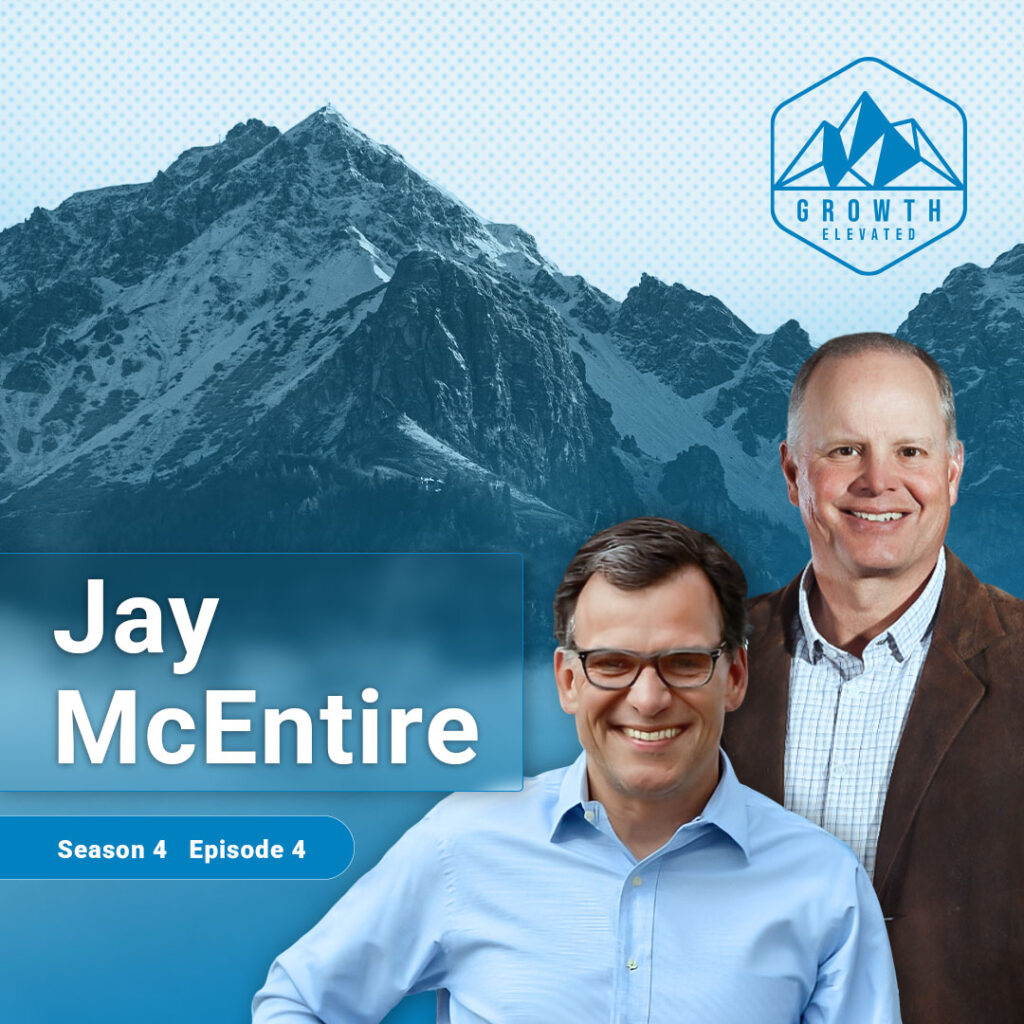
Transforming Agriculture Through AI and Regenerative Practices
In this episode of the Growth Elevated Leadership Podcast, host Julian Castelli sits down with Jay McEntire, founder and CEO of ARVA Intelligence, to explore how AI is transforming modern agriculture. Drawing from his journey from Wall Street to farming, Jay explains how data and machine learning are helping farmers make better decisions, reduce input costs, and improve long-term soil health.
For decades, U.S. agriculture has been driven by a system focused on producing low-cost commodities. This model has created significant pressure on farmers, who often bear the majority of the risk while larger industry players capture much of the value. As costs rise and markets become more volatile, the need for more sustainable and profitable farming practices has become increasingly urgent.
Jay highlights how regenerative practices combined with AI can restore soil health, reduce emissions, and create new economic opportunities through measurable environmental impact.
Key Takeaways:
AI Enables Better Farm-Level Decisions
By analyzing field-level data, machine learning helps farmers apply the right inputs in the right places, improving efficiency and reducing costs.
The Economics of Farming Are Under Pressure
Farmers face rising costs, market volatility, and structural imbalances where they take on more risk while others capture more value.
Regenerative Practices Improve Soil and Resilience
Adopting regenerative methods helps restore soil health, improve water retention, and reduce reliance on chemical inputs.
Reducing Inputs Lowers Costs
Optimizing fertilizer and other inputs can significantly reduce production costs while maintaining or improving yields.
Environmental Impact Can Become Economic Value
Measuring carbon reduction and soil improvements can create new revenue opportunities for farmers.
Ready to take your leadership to the next level? Explore expert insights, practical strategies, and powerful tools to elevate your impact in business.
👉 Visit us at GrowthElevated.com
📲 Follow us on LinkedIn for daily leadership inspiration and updates.
Let’s grow together!
Transcript
Julian Castelli (00:01.397) Hi, this is Julian Castelli and welcome to the Growth Elevated Leadership Podcast, where each week we talk with inspirational entrepreneurs and leaders in the tech industry. Past guests have included CEOs and CXOs of great companies like Workfront, CHG Healthcare, Pathology Watch, InMoment, Canopy, the San Francisco 49ers, and many more. This episode is brought to you by Growth Elevated. Growth Elevated is a community of tech founders, CEOs, and CXOs who are committed to working together to share best practices and learnings in an effort to help all of us become better leaders. We do this through educational programs like this podcast, as well as our blog, and of course, our annual Ski and Tech Summit, where we bring leaders to beautiful Park City, Utah, to enjoy collaborating and skiing and some learning about business. So if you enjoy any of that, check us out at growthelevated.com, and please subscribe to this podcast wherever you learn. listen to your podcasts. Today, I’m thrilled to welcome Jay McIntyre to the program. Jay is the founder and CEO of ARVA Intelligence. ARVA is an AI enabled optimization engine for the bio economy. They advance farmer profitability, ecosystem services, and human health. Jay combines a successful track record of FinTech and executive leadership and financial services software and energy. In addition to serving as chairman of Utah Gas Corps and the manager of Glencoe Farms, Jay has previously served as CEO of CogenC Software, which is a hedge fund risk management platform and CEO of ProTrader Group and Electronic Equity Trading Platform, which is acquired by Routers. So welcome, Jay. Jay McEntire (01:49.962) Welcome. Thank you, Julian. Good to be here. Julian Castelli (01:52.821) So Jay, I’m so excited to share your story. You’ve built Arva into a super exciting company, and it’s been an economic success, but you’re also doing something I know you’re passionate about. And you’ve got an interesting story weaving from Wall Street to farm to AI here. So let’s start with what Arva is, but then I want you to go back and. help us figure out how you had the idea. let’s first start with what Arva is today. What do you guys do at Arva? Jay McEntire (02:23.852) So ARVA is a technology platform for aggregating and organizing data in agriculture to now start to look at how do we have quantified environmental impact and optimize agronomic optimization. Effectively, we’re a spin out of Lawrence Berkeley National Lab. So we are at our core a science platform research. into the that’s focused on environmental sciences and earth observation. So what we’re trying to do is to to use the data and the observations that we get in farming to help farmers make better informed decisions, how they can become more profitable, more resilient and more environmentally impactful and more profitable themselves, sustainable profitability long term. Julian Castelli (03:20.638) What’s an example of something like you might tell a farmer that helps them become more profitable? Jay McEntire (03:24.94) Okay, so the key thing that we’ve been able to do is help grow from our research to working with large food companies around the world. So we’re in 12 countries this year across 12 different crops. So we’re helping farmers identify those practices that can reduce the emission profile of their grain. So in other words, how do we reduce input costs? How do we reduce the impact of additional too much nitrogen so we can reduce the nitrous oxide aspect and then start to move soil health so we can turn soil, improve soil by becoming a carbon sink at the same time. So as we go to, you know, think about if you go to Home Depot and you go get that black potting soil, it’s squishy. It’s got a lot of organic matter in it. That’s what we’re after is we’re happy to doing that. So if you take my farm in Arkansas, that land, Julian Castelli (04:11.144) Mm-hmm. Yeah. Yeah. Jay McEntire (04:21.321) was farmed by Native Americans for thousands of years. The organic matter was 10 or 12%. Mechanized farming comes in, chemicals come in, and we start to plow that field. It’s now at one, when I took it over and we started doing regenerative practices, it was 1.25%. Julian Castelli (04:25.763) Mm-hmm Julian Castelli (04:35.785) you Julian Castelli (04:42.217) That was the worst it got to. And so you had real experience with your own farm seeing this. have you got back to using your best practices and the AI that you have? Jay McEntire (04:49.931) So now we’ve added, so my co-founder Mark is 15 miles down the road. His family has been doing regenerative practices for 60 years. He has about 70 tons of carbon per acre more than I do at my farm. So he’s at 6 % organic matter, 1.25. We now have in just a very short period of time, if you go out to that field, you take a shovel and you go turn it over, you’re gonna find earthworms, grub worms. We never had that before. So you have a more living soil. And now that soil health is starting to give us the ability to have better water retention, better outcomes and less dependency on chemicals and fertilizer. Julian Castelli (05:33.833) So what was the organic matter you’ve brought your farm to? Jay McEntire (05:36.702) Now it’s getting up close to 2%. So it’s adding about on tons of carbon equivalent, that’s about 10 tons of additional carbon per acre. Julian Castelli (05:39.027) Got it, so you’ve doubled it. Julian Castelli (05:49.619) Got it. So that means it’s more sustainable and you can grow things more profitably and more efficiently. Jay McEntire (05:58.346) So if you look at, know, what are we, a great movie, people, if your listeners wanna explore this is, Woody Harrelson narrates a movie called Kiss the Ground. And in that movie, you see regenerative farming and you start to see in the US, we’re a huge carbon sink during the growing season as those plants and that photosynthesis and those plants are growing. We’re taking energy from the sun and we’re taking carbon out of the atmosphere. We’re sticking it in the ground. Julian Castelli (06:08.296) Okay. Julian Castelli (06:27.528) Mm-hmm. Jay McEntire (06:28.274) So effectively what we’re looking at is how do we leverage this natural system to be a carbon sink for as a way to reduce the overall carbon emissions. But we’re also looking at it when we look at our clients, our downstream clients like Nestle, and Mars, a Pepsi, and these world’s Walmart big food companies are interested in reducing the emission profile of the grains that they buy for their products. Kelenova. Julian Castelli (06:35.646) Mm-hmm. Jay McEntire (06:55.924) We did a lot of work in Cheez-Its. We have net negative wheat going into Cheez-Its, believe it or not. Great experience we had at New York Climate Week a couple of years ago. So what we’re after is quality, improving the quality of the grains. We’re about how can we use this ecosystem now for what we ecosystem services, how we can deliver more environmental impact, sequester carbon. Julian Castelli (07:23.23) Mm-hmm. Jay McEntire (07:24.572) and produce lower carbon intensity grains and then improve the resiliency of the supply chain. So, but to do that, Julian, we have to put a value on that. And we have to put a value on that because we’re competing in a global commodity market. And when you’re in a global commodity market, you’re rewarded for being the lowest cost producer. So there’s a race to the bottom and you do things that are expedient and Julian Castelli (07:31.116) Mm-hmm Julian Castelli (07:46.216) Right. Jay McEntire (07:52.552) you do things to be able to produce low cost calories. Our food policy from the governments from the 70s, from Nixon on, has been cheap calories. And so we produce a lot of cheap calories. We export them. Julian Castelli (08:00.007) Mm-hmm. Julian Castelli (08:06.943) Mm-hmm. And so that creates the problem. then now you’re kind of rehabilitating these farms. Jay McEntire (08:15.473) Our goal is to put a value on creating the same commodities that we need for our food production, but do it in a way that can be environmentally impactful to help these companies meet their SBTI or their climate commitments, but also to give them the competence that we have a sustainable food system. They need to know that they can get X amount of grain out of Arkansas for rice or wheat out of North Carolina. Julian Castelli (08:38.205) Mm-hmm. Jay McEntire (08:44.211) They need to know that that production is gonna be there consistently, because they can run their mills and they can run their operations. And in this low cost commodity environment, we’re gonna lose a lot of farmers this year. be the highest level of bankruptcy since the last farm crisis. And this year, the number of suicides from farming is going through the roof. There are a number of farmers. Julian Castelli (09:02.833) This year? Wow. Julian Castelli (09:10.542) Is that because it’s just such a hard business? Jay McEntire (09:12.688) It is a hard business in the price of commodity. I met with Anheuser-Busch last week at Commodity Classic. They’ve already lost 20 % of the production that they were counting on direct from farmers into their mills. they Bud Light and Budweiser brewed with rice and they had direct suppliers and large suppliers are ruling out a business. So it’s a tough environment for farmers. And if we can start to put more value and help turn this system around, where we can empower the farmer with more data to make better agronomic decisions so he can lower his cost of production and optimize for that, optimize genetics by environment, optimize biologicals by environment, then he can start to have a fighting chance to be sustainable without government subsidies. Right now, we’re a bit dependent on government subsidies. And then create additional value on top of that for the ecosystem service that he can provide for reducing carbon and sequestering carbon. Julian Castelli (10:19.814) Got it. So, Jay, tell me, let’s back up. How did you go from Wall Street to be digging in the dirt and finding the worms and, and, you know, doing this AI science and on the farm that that’s quite a transition. Jay McEntire (10:33.928) It was, was serendipity happens, you know, in life and you have to be, you know, be in a position to get lucky and, and, and then take advantage of that. So I met our friend, Mark Sunday invited me to a conference in 2016 at Deer Valley and on future and review, a bunch of futurists getting together and Ben Brown, my co-founder, was speaking on behalf of Lawrence Berkeley Labs on phosphate mobilizing microbes and things like that, that would allow us to think about how to become more sustainable using biology, not just chemicals and et cetera. So I went up to him and I said afterwards, said Ben quit screwing around in the lab. Let’s go do this on a thousand acres in Arkansas. So we did. We created, it was on my farm. So we created ar1k.org. Julian Castelli (11:24.687) Was that your farm? Jay McEntire (11:29.765) It was a collaboration between Glen O’Farms, Oak Ridge National Labs, Lawrence Berkeley Labs, and the University of Arkansas. So for three years, we did research and using, Ben was also head of the machine learning initiative at Lawrence Berkeley Labs. And out of that, we were able to create, he published a paper on iterative random forest, which was a model, know, ML model. And using that model, we were able to determine what the phosphate response curve was for growing a crop. So if you put on more fertilizer, past a certain point, you didn’t get a response from the plant. So using that model, we saved ourselves $20 an acre on not over fertilizing. Nathan Slayton did a small plot trial at the same time and did the exact same number. So whether we got lucky, might have been fat finger, I don’t know. Julian Castelli (12:04.677) Mm-hmm. Julian Castelli (12:12.347) you Jay McEntire (12:27.057) But it was enough for me to say, let’s start a company. Julian Castelli (12:30.153) So you saw someone presenting, you invited them to your farm, you proved the concept, and did you know how you’re gonna make money on this? Because you’ve been through it, but you knew it was good for farming. And you’ve been through a few business models, haven’t you? Jay McEntire (12:38.961) I had no idea. No idea. It was good for farming. I have. But the aspiration hasn’t changed. Empower Julian Castelli (12:51.547) The ultimate, what, you why don’t you summarize, what were the ultimate vision you had when you decided to start this company? Jay McEntire (12:56.218) Right. So when we start to think about putting power back in the farmer’s farmers are dependent on large agrochemical companies, large agriculture manufacturing companies, and for the government to grow crop insurance. So those three, those agrochemical companies, the seed companies, the Monsanto’s, the beers, they all get paid first. Julian Castelli (13:23.834) Mm-hmm. Jay McEntire (13:25.03) farmer takes all the risk. And I knew it’s not true that the marketing from these companies say this is the best seed genetics. Well, that can’t be true in sand and clay. And I got that in the same field. We’re in the mid-south. in the Mississippi Delta. So this just doesn’t make sense. So when I went to, when we started doing this research, we had three tenant farmers on the farm and on 3,000 acres. So they each farmed about thousand acres. We did one acre grid samples. We did some additional measurements and we gave it to all the chemical companies that were revising these farmers. And they all came back with the same recipe. It was all spread in peanut butter, just this much fertilizer go, you know, and it was just like no nuance to these fields. And from my background going, wait a minute, I got 65 fields. They’re all a little bit different. Julian Castelli (13:58.702) with them. Julian Castelli (14:17.529) Mm-hmm. Jay McEntire (14:23.055) This is more like, what does the Morningstar report look like on this farm? And then let’s start to address what the recipe needs to be for this unique field. Julian Castelli (14:26.649) Yeah. Julian Castelli (14:32.923) So you were kind of creating micro recipes for each part of the land and that made the big difference versus this peanut butter. Jay McEntire (14:35.831) Exactly. That’s right. It made a huge difference. And then when you start to think about the peanut butter approach, again, that’s lined with producing cheap calories. Just go big, produce cheap calories, go. Julian Castelli (14:48.889) Yeah. Julian Castelli (14:52.258) And it also means you’re buying more fertilizer from the large industry, right? So they like that. So it’s probably aligned. Jay McEntire (14:55.973) who are the ones given that. So the mission has always been about empowering the farmer to make better decisions. And if we can do that, we’ll figure out how to make money. But not only that, in doing so we lowered, we did research. Our first funding came from the Department of Energy. And then we worked for the first four years, we were a contractor with the Department of Energy. Julian Castelli (15:02.874) Mm-hmm. Jay McEntire (15:22.821) Advanced Research Program Agency for Energy. The goal of that was to measure the emission profile of corn crops and other biofuel crops to produce a net negative fuel source. So all the work that the Department of Energy did on low carbon intensity fuel, biofuel, we were part of all that research. So that gave us kind of the bona fides and the credentials. Julian Castelli (15:48.366) because Jay McEntire (15:51.301) to now wade into the space when these large food companies were looking for how do I source low carbon intensity grain so I can meet my climate pledges, we had the technology, we had the experience, we had the measurements, and then we started working through farmer owned cooperatives to enroll farmers and our business and just grew from there. Julian Castelli (16:15.149) That’s fantastic. you you kind of shared with me kind of a negative view of, man, it’s really hard to be a farmer and a lot of them are going out of business even today. Do you have a more optimistic view about farming in the US going forward? Do think that the industry is going to adopt these techniques in time to make it much more profitable and sustainable? Jay McEntire (16:36.599) I am optimistic, Julian, I am optimistic that this plus the biofuel market is about to come online in a big way in the US. I think that’s gonna, will it save the farmers this year? We’re gonna need more government assistance to step in. And in some cases, it’s already too late. Some farmers are ready to plant and the government assistance that’s been promised hasn’t materialized. This war in Iran is going to drive up fertilizer prices. A lot of the fertilizer is produced in the Middle East and shipped to the US. So this is going to increase the cost to farmers. And so we need to be prepared. We need our government to not screw up our export markets. That’s been a big negative impact. So there are so many things. Julian Castelli (17:15.211) Mm-hmm. Julian Castelli (17:26.777) Mm-hmm Julian Castelli (17:31.99) Yeah, there’s so many things that impact the farmer when you peel it back. It’s a tough business. Jay McEntire (17:35.108) However, I’m very optimistic that what we’re doing and we’ll pay out over $100 million to farmers through the end of this year over the past four years. So we’re still small relative to the size of the industry. Yes. Julian Castelli (17:50.808) paying out in terms of carbon credits or what? So this is a way they can help monetize their farms and you’re helping them do that. That’s huge. that might be the difference between losing money and making money for these farmers, right? Jay McEntire (17:56.516) 100%. That’s right. Yeah. It is, it is in a lot of cases and or being able to plant a crop next year. So we’ve heard from a lot of our farmer. Julian Castelli (18:09.452) Yeah, so you help them generate profit and keep their farms healthier. That’s pretty great. So Jay, that’s amazing. And I know that you’ve been keeping me up to speed and you’ve had lots of different models, but it’s been about six years now, right? And you went from eight employees to now over 60 employees and you’ve grown your business tenfold. Jay McEntire (18:36.077) Yes. Julian Castelli (18:37.112) That’s amazing. What are you most proud of in the journey so far? Jay McEntire (18:41.316) Well, the most proud, two years ago, I was at Commodity Classic and a farmer came up to me and he said, you’ve changed my life. And he was an older farmer and he was trying to get his family to start to think about how do we become more resilient, really adopt more regenerative practices and how do I get my younger family members more engaged? And this gave him an opportunity to show I can make both an impact on the environment, become a better steward of the land and get rewarded for it. And that was probably one of the highlights of my career, believe it or not. I’ve had some pretty fun things, I’ve some bad things, but as an entrepreneur, you have wins and losses. That was the most impactful. And to really see that what we’re doing not only is having an impact on my own land, but now Julian Castelli (19:33.143) and Jay McEntire (19:39.949) getting recognized and helping these farmers get recognized for the impact that they can make. Julian Castelli (19:44.779) That is fantastic. Has Arva as a company been recognized in being able to make these dreams happen? Have you guys gotten some recognition for that? Jay McEntire (19:55.969) Well, we made it through the Southwest Finals for Entrepreneur of the Year last year. We’ve been, or the year before last, we’ve been, we’re invited to speak on a lot of panels. We were at Green Biz last week. were New York Climate Week. I was at Davos. So, I mean, it’s been, we’re recognized as a leader. Julian Castelli (20:23.361) So you’re getting recognized, and I suspect there’ll be even more so as you continue to grow the business. Congratulations. What was the biggest challenge as a leader that you had to overcome to get here? It wasn’t an easy road, right? You had to knock on many doors and try lots of different business models. Jay McEntire (20:25.811) Absolutely. Jay McEntire (20:29.41) Thank you. Jay McEntire (20:41.954) think the key thing, you know, that you have to be as an entrepreneur is one is you have to persevere and be very resilient and you have to have you have to have hope and confidence that you’re going to get there. So the transition has been. Persevering when others are skeptical and be true to your mission, true to things, nothing’s changed. We’ve been very consistent in our mission. Julian Castelli (21:04.371) Mm-hmm. Jay McEntire (21:11.829) We’ve been very consistent in terms of the technology and the roadmap we’re after. So now we’re just finding more derivatives to be able to have an impact. Human health is going to come out of this at some point. It’s going to be pretty exciting. So where we’re after, where we’ve been so passionate, we haven’t really changed the core mission. The business opportunities have just manifest into ways that we hadn’t expected. So it’s not so much changing who we are or what we do. It’s been staying consistent and focused. Now, as a leader, the hardest thing has been going from visionary chief, know, bottle washer, you know, taking out the trash, staying up, you know, I’m still working like I was a 23 year old investment banker and sometimes working overnight to get deliverables out the door as we’ve grown our business. Julian Castelli (21:53.344) From the top to the bottom, Jay McEntire (22:05.058) So that’s been exciting. And so now we’re really at a point where our business has grown. I’ve been able to build a team over the last 18 months. And so now I’m hopeful to transition and educate that and put more responsibilities and look for other ways to get out of the day to day to stay focused on the big prize. Absolutely. Julian Castelli (22:24.471) Well, you can be more of the visionary and the leader. So that’s fantastic. What do know now that makes you a better leader than that you’d take in the future or that you’d recommend to our listeners? What kind of lessons can you share? Jay McEntire (22:41.483) take one back to the resilience, knowing that there are to be ups and downs. You and I have shared some conversations that looking at life can be random. The book Ecclesiastes really tells us that. It doesn’t matter who you are or how smart you are. Randomness can happen, but it can also lead to good outcomes. So persevering in business allows you to have Julian Castelli (23:03.595) Mm-hmm. Jay McEntire (23:11.421) meet serendipity and opportunities like when I met Ben, like when we were at Field to Market and that opened the door for us doing work and rise and then opened the door to now, you know, we’ve been able to expand with some of our global clients into Indonesia, we’ll be in Philippines, we’ll be in Thailand next year. So you go from, you know, humble beginnings and just focus on getting work done to now being able to transition and grow up a team. And that is a tough transition. Julian Castelli (23:38.356) Mm-hmm. Jay McEntire (23:40.65) to be able to keep that energy and that momentum going while you’re changing hats, right? I’m not working any less than I did when I was doing all the jobs, but I am working the same, but also having to transition to where I’m spending my energy and investing in the team below me to take on more of those responsibilities. Julian Castelli (24:06.025) Well, that’s fantastic. I’m excited for your next chapter, Jay, and congratulations on both the financial success, but also the mission that you’re having for this important industry in the United States and across the world. And I know it’s close to your heart with your own farm. It must be really satisfying to have that success on both levels. Is there anyone that you want to acknowledge on the journey that’s been helpful to you on this journey? Jay McEntire (24:25.396) It’s been fun. Well, could not have done this without my wife, Lisa. Lolly is her grandkids scholar. She’s just been an amazing companion. We’ve been married for 42 years and she’s been the rock. We also raised multiple dogs and four children and now we have a grandchild. that’s, yeah, thank you. And so. Julian Castelli (24:45.172) It’s a beautiful family. Jay McEntire (24:50.144) Couldn’t have done it without her. She was top of the class, I was not. So we married above myself and stayed committed through that. So couldn’t be there. My co-founder Ben Brown, Mark Isbell, have just been amazing. We’re very close. We’ve now been working together from three years before we started ARVA, from 2016 to today. Julian Castelli (24:53.48) Haha. Jay McEntire (25:16.929) 10 years, we built an incredible company and it’s really exciting. And then my chairman, Charles Tate, who’s an investor, but has been an incredible supporter and visionary for us. So we’ve got a great team and all the Arvinauts we call them, they’re an amazing group of folks. we’re just having a working hard, but we’re succeeding and we’re having a lot of fun. Julian Castelli (25:46.047) Well, that’s great to hear, Jay. It sounds like a great, great team. I imagine it would be with your leadership. For our listeners, tell me where you’ve been inspired. Any books or podcasts that you’d recommend other people listen that were impactful for you? Jay McEntire (26:01.524) Yeah, I’m, know, podcast, think A16Z, you know, Andreessen Horowitz, they’re doing a great job of kind of keeping the forefront of, you know, applied AI and business structures. So that’s a great, keep an eye on. You know, Peter Diamandis, you know, keep it, keep it, they can get. Jay McEntire (26:32.16) looking at like to listen to Pints with Aquinas. so, yeah. Okay, so top podcast that I’m listening, you want to go back for, yeah, so top. Julian Castelli (26:32.164) Thank you. Julian Castelli (26:37.373) Hey Jay, start again, I lost you for a second there. Julian Castelli (26:46.259) Yeah, go ahead and tell me what’s inspiring you these days that you might recommend for our listeners. Jay McEntire (26:51.327) Yeah, so I’m keeping up with A16Z, Andreessen Horowitz. Definitely keep up with the great business models in applied AI. So that’s a good place to keep current on that Peter Diamandis moonshots. Can get a little bit long winded, but that’s also another place to kind of keep up to date. I don’t subscribe to some of the Julian Castelli (27:16.84) Sure. Jay McEntire (27:20.349) or extreme outcomes of no work and every pod, you know, that’s not gonna happen in my view in terms of AI taken, but it’s good to hear those views. And then, you know, to keep myself grounded and, know, where I’m faith that I listened to pints with Aquinas and to kind of keep it balanced out. Julian Castelli (27:42.257) Nice, that’s a unique one, I love it. Well, thanks for sharing your journey with us, Jay, and congratulations, and we’ll look forward to seeing you out there on the ski slopes someday, soon. Talk to you soon, bye. Jay McEntire (27:51.871) All right, Betty, good to see you. Thanks so much. See you.
Timestamp
Introduction & Guest Welcome (00:01)
Julian introduces Jay McEntire, founder and CEO of ARVA Intelligence.
What ARVA Does (02:23)
AI platform helping farmers improve profitability, soil health, and environmental impact.
Rebuilding Soil with Data (04:21)
Jay shares restoring his farm from 1.25% toward regenerative organic matter levels.
Carbon as Farmer Revenue (06:28)
Helping farmers monetize lower-carbon grain with major food companies.
Farmer Profit Crisis (08:44)
Bankruptcies rising amid commodity pressure and rising input costs.
From Wall Street to Farming (10:33)
A serendipitous lab partnership led to launching ARVA.
Precision Over “Peanut Butter” Farming (13:25)
Field-specific optimization replaces one-size-fits-all fertilizer approaches.
$100M Back to Farmers (17:35)
ARVA payouts helping farmers stay solvent and plant another season.
Leadership Lessons (20:41)
Resilience, mission consistency, and scaling from operator to visionary.
Closing & Inspiration (27:42)
Optimism for farming’s future and key influences shaping Jay’s leadership.